06: Can It Make Another One?
In the last chapter, we damaged persistent patterns.
That gave us:
persistence
≠
robustness
≠
regeneration
Now consider a different possibility.
Instead of asking whether one organization can continue forever, ask:
Can one organization cause another recognizable organization to appear?
That is reproduction in its weakest interesting form.
But we should be careful immediately.
Digital systems make copying cheap.
So cheap, in fact, that:
copying
by itself tells us almost nothing.
The real question is not:
Can digital state be duplicated?
Obviously it can.
The interesting question is:
Can the dynamics of the system itself produce another instance, and can we demonstrate a causal relationship between them?
That is much harder.
The World’s Worst Self-Reproducer
Start with the stupidest possible example.
def reproduce(x):
    return x.copy()
Then:
parent = [1, 0, 1, 1]
child = reproduce(parent)
Now:
parent = 1011
child  = 1011
Did the system reproduce?
In one trivial sense, yes.
Some state was copied.
But nearly everything interesting came from outside the supposed organism:
where the object begins
what counts as the object
when copying happens
how copying works
where the new copy goes
The function name:
reproduce()
does not establish reproduction as an internal property of the system.
That would be exactly the mistake this book is trying to avoid.
Copying Is Native to the Digital Substrate
Computers already duplicate things constantly:
files
memory pages
processes
database rows
containers
virtual machines
model checkpoints
This matters because the digital substrate differs fundamentally from biology.
Copying digital state is often:
cheap
fast
exact
So we should not automatically treat duplication itself as a profound achievement.
The interesting part is where the mechanism lives.
Compare:
external copier
     ↓
duplicate state
with:
local dynamics
     ↓
new recognizable instance
Those are very different claims.
    flowchart LR
    subgraph External
    A[External copier function] --> B[Duplicate state]
    end
    subgraph Internal
    C[Local dynamics + rule] --> D[New recognizable<br/>instance arises]
    end
    B -.- E[Not reproduction as<br/>internal property]
    D -.- F[Potentially interesting<br/>self-reproduction]
Remove the Reproduction Function
Imagine a cellular automaton.
There is no:
spawn_child()
No object constructor.
No hidden supervisor identifying parents and children.
There is only:
local state
+
neighborhood
+
transition rule
+
time
Yet eventually:
one localized organization
is followed by:
two spatially separated recognizable organizations
Now something more interesting has happened.
The mechanism that produces the second structure is embedded in the same local dynamics governing everything else.
There is no privileged reproduction API.
That is the kind of reproduction we care about.
What Counts as Another One?
Suppose a configuration C appears here:
C
Later:
C C
Have we demonstrated reproduction?
Not yet.
We immediately need an identity criterion.
How similar must the new configuration be?
Exactly identical?
Translated?
Rotated?
At another internal phase?
Slightly different?
What if the original changes while the second appears?
Again, the question:
Did it make another one?
contains another question inside it:
What counts as the same kind of thing?
Chapter 04 has returned.
Identity is not an optional philosophical decoration.
It determines whether our detector reports:
1 entity
or:
2 entities
Growth Is Not Necessarily Reproduction
Suppose:
###
becomes:
######
and then:
#########
The structure became larger.
Did it reproduce?
Probably not.
There may still be only one continuing organization.
So reproduction usually requires something stronger:
one candidate entity
        ↓
two defensibly distinct candidate entities
That means we need some separation criterion.
Perhaps:
spatial separation
Perhaps later:
causal separation
For now, geometry gives us a first approximation.
But we should already mark it as provisional.
A digital individual may eventually turn out not to correspond neatly to one connected blob.
Similarity Is Not Parenthood
Now suppose the world spontaneously creates the same pattern every 100 generations.
C
Then later:
C C C C
We might see many copies.
But imagine removing the first one.
The later copies still appear at exactly the same times.
Was the first C their parent?
No useful evidence supports that.
So:
similarity
+
later appearance
is not enough.
We need causality.
Causal Reproduction
Compare two worlds.
World A
candidate parent present
        ↓
candidate offspring appears
World B
candidate parent removed
        ↓
does candidate offspring still appear?
    flowchart TD
    subgraph A [World A: Parent present]
    A1[Parent exists] --> A2[Offspring appears]
    end
    subgraph B [World B: Parent removed]
    B1[Parent absent] --> B2[Offspring still appears?]
    end
    B2 -->|Yes| Weak[Weak evidence<br/>parent not causal]
    B2 -->|No/Delayed| Strong[Stronger evidence<br/>parent is causal]
If removing the supposed parent prevents, delays or substantially changes production of the supposed offspring, then the parent hypothesis becomes much stronger.
This is the same principle we introduced in the previous chapter:
Intervention tests whether the proposed mechanism is doing real work.
That gives us a much stronger reproductive claim:
parent-like organization
        ↓
causally contributes
        ↓
production of distinct offspring-like organization
Now the word:
parent
starts earning its meaning.
A Minimal Reproduction Test
Suppose we detect candidate pattern P.
A useful first protocol might be:
- identify
Pat time t₀ - track
Pthrough time - detect another spatially distinct pattern satisfying the identity criterion
- verify that the new pattern persists independently for some minimum time
- repeat the observation
- remove or perturb
P - measure whether production of the new pattern changes
    flowchart LR
    A[Identify P at t0] --> B[Track P]
    B --> C[Detect distinct<br/>similar pattern]
    C --> D[Verify new pattern<br/>persists independently]
    D --> E[Repeat observation]
    E --> F[Remove/perturb P]
    F --> G[Measure change in<br/>offspring production]
Notice how much more demanding this is than:
Look! Two blobs!
That is deliberate.
Replication and Reproduction Are Not Identical Questions
Suppose the parent produces:
101101
and the child is:
101101
That is an exact copy under this representation.
Call that replication.
Now suppose offspring can differ:
parent
101101

child
101001
Now we have variation.
But variation alone is still not enough to tell us much.
The next question is whether the difference survives into further descendants.
Variation Is Not Inheritance
Suppose:
Generation 0
101101

Generation 1
101001

Generation 2
101001

Generation 3
101001
Now the altered property has persisted through reproduction.
That is much closer to inheritance.
So:
variation
is not the same as:
heritable variation
A one-generation error may be noise.
An inherited difference can alter the future of a lineage.
Parenthood Becomes a Graph
Once offspring can produce offspring, the experiment changes again.
Instead of merely counting objects, we can represent:
A
├── B
│   ├── D
│   └── E
└── C
    └── F
Now we have a lineage graph.
    graph TD
    A[A] --> B[B]
    A --> C[C]
    B --> D[D]
    B --> E[E]
    C --> F[F]
This is important.
We are no longer only measuring:
how many patterns exist?
We can ask:
who descended from whom?

which branches persist?

which properties recur within branches?

which variants spread?

which branches disappear?
Reproduction introduces history with structure.
Count Descendants, but Do Not Stop There
A simple measurement is:
recognized descendants through time
For example:
t = 0      1
t = 100    1
t = 200    2
t = 300    4
t = 400    7
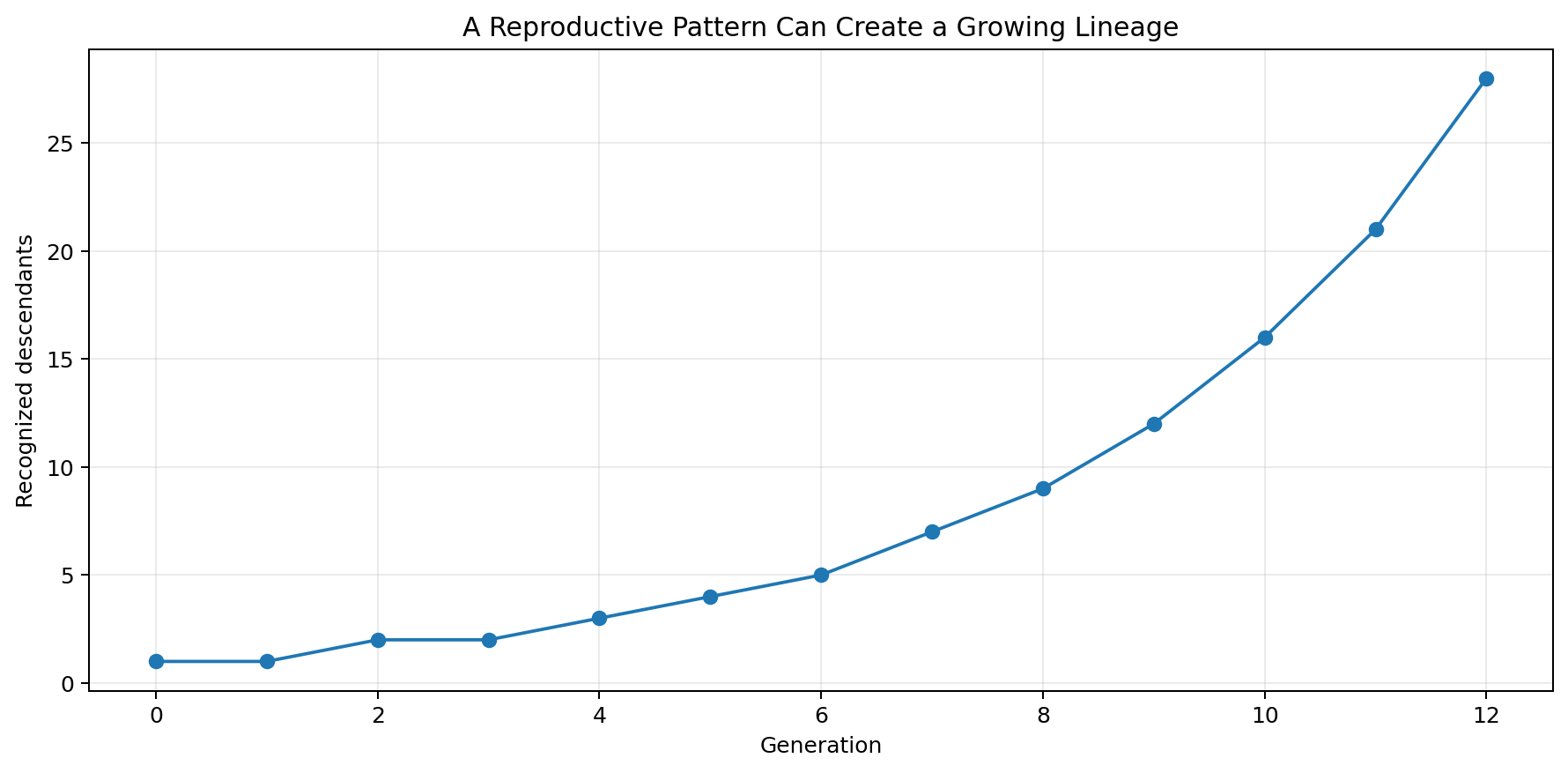
This tells us whether a structure duplicated once or participated in a growing lineage.
But raw counts are not enough.
A lineage graph tells us far more than population size alone.
Two systems may both contain 100 copies while one came from one deep branching ancestry and another came from 100 independent spontaneous appearances.
Those are completely different mechanisms.
Self-Reproducing Cellular Automata
This problem has a long history.
Von Neumann’s work on self-reproducing automata was not merely about making shapes duplicate.
The deeper problem involved a machine participating in the construction of another machine while also propagating the information needed for that construction.
Later cellular-automaton systems simplified the machinery.
Langton’s loops became one famous example of local dynamics producing self-reproducing structures.
Then systems such as Evoloops pushed the idea further by allowing variation among reproducing structures.
The important lesson for us is not the historical sequence itself.
It is the mechanism:
local rules
+
localized organization
+
reproduction
+
variation
without requiring an external function to identify and copy the object.
Evoloops: Reproduction Without a Fitness Function
Evoloops are especially interesting because reproduction occurs inside the world.
Interactions and collisions can create variation.
Some variants remain able to reproduce.
So instead of:
A
↓
A
↓
A
we may obtain:
A
↓
A'
↓
A''
and those differences can alter what happens later.
That matters because there need not be an external loop saying:
score = fitness(candidate)
if score > threshold:
    reproduce(candidate)
Instead:
successfully reproduce
        ↓
more descendants
or:
fail to reproduce
        ↓
lineage disappears
The environment and dynamics produce differential reproductive success directly.
That is a very different architecture from ordinary optimization.
Determinism Does Not Prevent Evolution
There is a temptation to think:
deterministic universe
means:
no evolution
But those ideas address different questions.
Determinism says:
Given the complete present state, the future state is fixed.
Evolution concerns relationships among:
variation
inheritance
differential reproduction
Those relationships can exist inside a deterministic trajectory.
Randomness is not logically required.
Variation is.
Outlier Makes the Problem Stranger
More recent cellular-automaton work gives us an even more interesting case.
In the system called Outlier, simple binary local dynamics can generate structures that appear to replicate at more than one spatial scale.
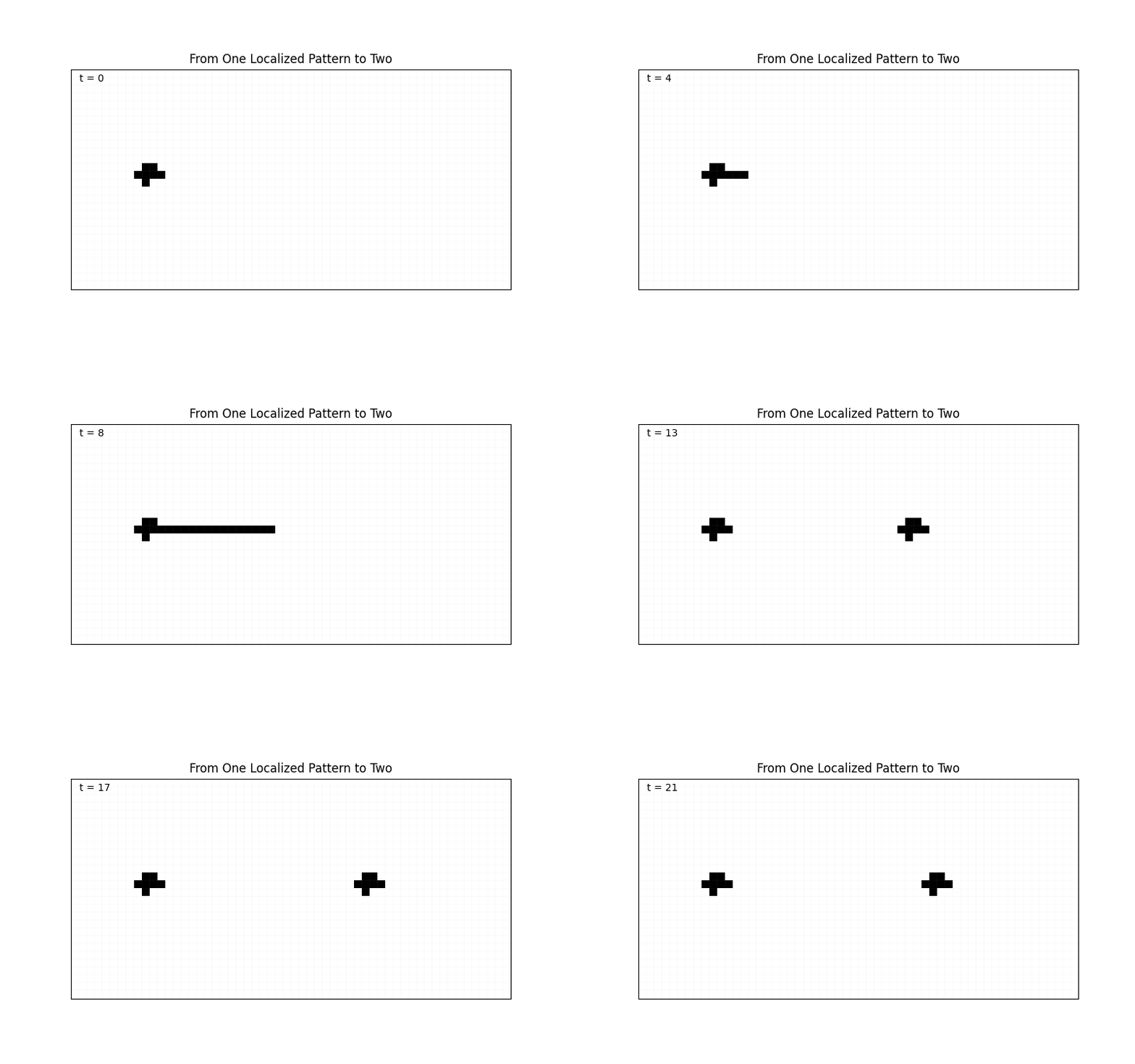
That is exactly the kind of observation that should make us suspicious.
Not dismissive.
Suspicious.
Because the image invites the sentence:
It reproduced.
But now we know what that sentence requires.
We must ask:
Are there really distinct entities?

Are they persistent?

Are they related by ancestry?

Does the supposed parent matter causally?

Does the process repeat?

Do descendants themselves produce descendants?
The visual phenomenon is only the start.
This will matter later. A lot.
The Most Dangerous Word Here Is “Offspring”
Suppose a blob divides:
OOOOOO
into:
OOO OOO
Our eyes immediately construct:
parent
+
child
But several alternatives may explain the same image.
Perhaps:
one object fragmented
Perhaps:
two structures emerged from a shared surrounding process
Perhaps:
the apparent parent was not causally necessary
Perhaps:
our entity detector split one distributed organization into two pieces
So the word offspring must be earned by ancestry evidence.
Geometry alone is not enough.
Mutation Is Not Evolution
Now suppose we explicitly implement:
child = parent.copy()

if random.random() < mutation_rate:
    child[random_index] ^= 1
Have we built evolution?
No.
We have implemented:
copying
+
mutation
Evolution requires a population-level process over generations.
At minimum:
heritable variation
+
differential reproductive success
+
change in variant frequencies through time
That distinction is crucial.
A mutation operator is not an evolutionary result.
And Evolution Is Not Progress
Suppose a population changes for 10,000 generations.
Variants arise.
Variants disappear.
Lineages branch.
Different forms dominate at different times.
Evolution may certainly be occurring.
But perhaps:
capability does not increase

useful structure does not accumulate

each useful change is later lost

later generations do not begin ahead of earlier ones
Then we should not automatically say progress.
Evolution and cumulative improvement are different claims.
This is going to matter in the next chapter.
A Lineage Creates a New Kind of Persistence
Earlier, persistence meant:
one organization
continuing through time
Reproduction allows another possibility:
organization A
      ↓
organization B
      ↓
organization C
      ↓
organization D
No individual needs to continue indefinitely.
Some relationship may persist across successors.
That relationship could involve:
shape
internal state
parameters
encoded description
behavior
learned information
But we must not assume in advance which of these matters.
The experimental question is:
What remains correlated across ancestry?
That is a much cleaner formulation of inheritance.
Digital Lineages May Not Resemble Biological Lineages
This is where we need to resist importing biology too quickly.
Biological lineage is usually drawn as a tree:
parent
├── child
└── child
Digital systems may allow stranger possibilities.
A digital entity might:
fork
copy
checkpoint
restore
exchange state
merge
So ancestry could eventually look more like a graph than a tree.
    graph TD
    A[Parent] --> B[Child 1]
    A --> C[Child 2]
    B --> D[Descendant]
    C --> D
    D --> E[Merged descendant]
    B -.->|checkpoint| F[Restored copy]
    F --> G[Alternate continuation]
Two descendants might exchange information.
Two branches might merge.
A restored checkpoint might create another continuation from an earlier state.
That means even the concept lineage may need a digital version rather than a biological copy.
For now, simple parent-child reproduction gives us a clean starting laboratory.
But it may not be the final architecture.
Our Vocabulary Is Becoming Dangerous
We now have words such as:
individual
parent
offspring
replication
reproduction
variation
inheritance
selection
lineage
evolution
Every one can become cargo cult.
So translate them back into operational questions.
| Word | Operational Question |
|---|---|
| Individual | Can we define a pattern or causal organization sufficiently well to track it through time? |
| Parent | Does one candidate entity causally contribute to the appearance of another? |
| Offspring | Does a distinct continuing organization appear as a consequence of that process? |
| Replication | Does the offspring satisfy an identity criterion equivalent to the parent’s? |
| Variation | Does the offspring differ on some measured property? |
| Inheritance | Do parental properties predict corresponding descendant properties across generations? |
| Selection | Do inherited differences alter expected reproductive success under the environment being tested? |
| Evolution | Do inherited variants change in prevalence across generations? |
Those are questions we can test.
Reproduction May Not Be Fundamental
There is one more thing we should refuse to assume.
Biology depends heavily on reproduction.
But biology also contains:
finite bodies
aging
damage
death
limited individual growth
A digital system may not inherit those constraints.
It might instead:
continue growing
self-modify
expand memory
repair indefinitely
fork only when useful
checkpoint and restore
distribute itself across machines
So reproduction may eventually turn out to be important without being fundamental.
We are studying it because it enables ancestry, inheritance and population dynamics.
Not because we have already decided that every digital life-form must reproduce.
So Can It Make Another One?
Yes.
Digital systems can certainly produce copies.
More interestingly, cellular automata can contain local dynamics from which new recognizable structures arise without an external reproduction API.
And systems such as Evoloops and Outlier give us increasingly challenging cases in which reproduction, variation and ancestry become serious experimental questions.
But the useful sequence is not:
looks like replication
↓
therefore reproduction
↓
therefore life
It is:
    flowchart TD
    A[Candidate entity] --> B[Distinct second entity]
    B --> C[Similarity]
    C --> D[Causal dependence]
    D --> E[Repeated production]
    E --> F[Lineage]
    F --> G[Heritable variation]
    G --> H[Differential reproduction]
    H --> I[Evolution?]
And only after that do we get to ask about evolution.
The Question Changes Again
Suppose we establish all of this.
We have:
reproduction
variation
inheritance
selection
What happens over generations?
Do variants simply churn?
Do lineages remain static?
Does one type replace another?
Does the population adapt to its environment?
Does anything accumulate?
And perhaps most importantly:
Can later generations begin from something genuinely better than earlier generations?
That is no longer a question about reproduction.
It is a question about evolution.
Next: Evolution Without Life?
