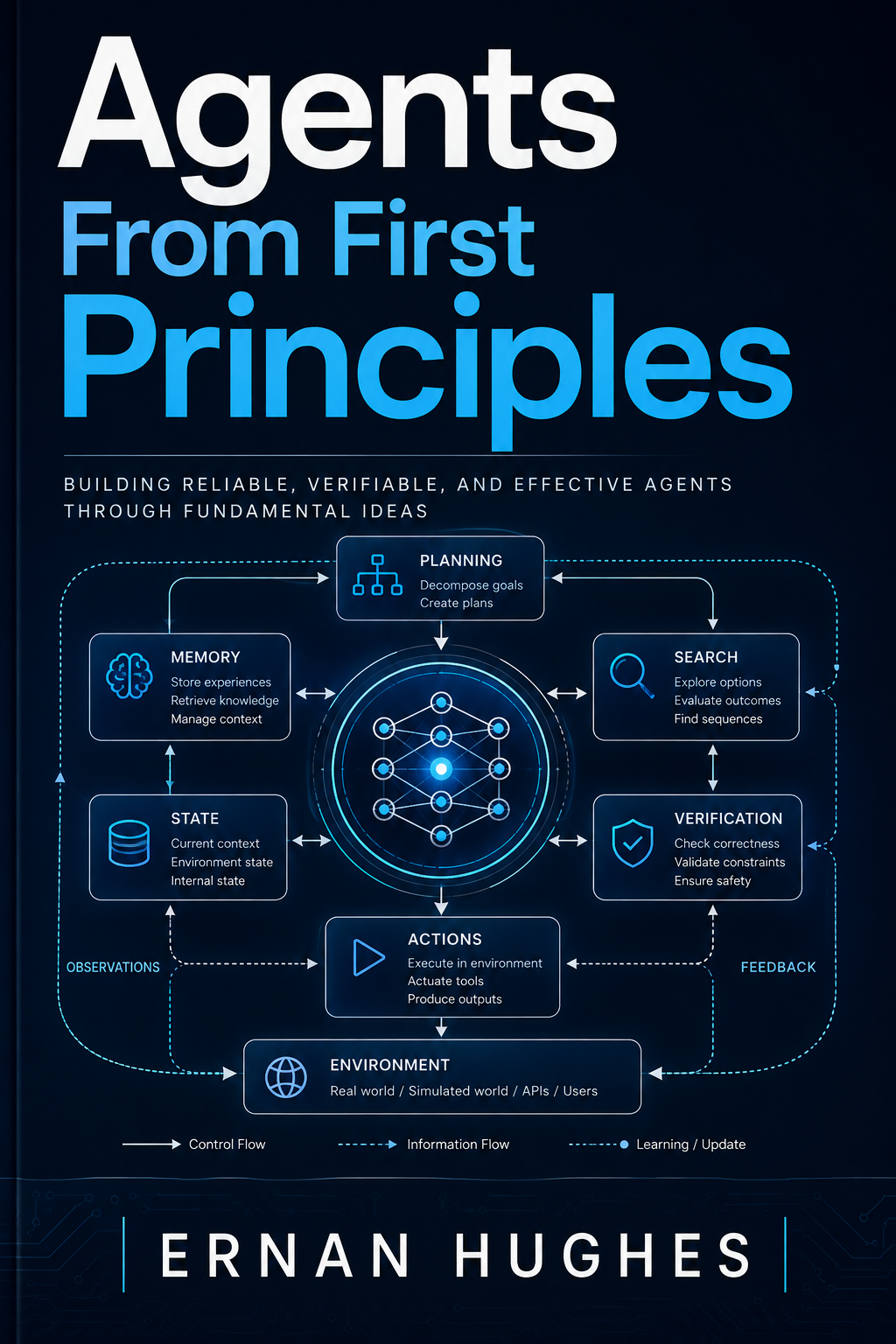
The books work through difficult subjects from first principles. The goal is not to stop at explanation: each path should lead toward something that can be built, tested or used.
A standalone memory runtime for AI agents that separates retrieval, historical recall, temporal validity, current work, trust, decisive selection, traceability, unfinished work, and explicit memory writes from permission to influence present behaviour.
A relation-aware embedding runtime that measures identity, compatibility, preservation, and policy-scoped usability instead of trusting raw vector similarity.
ZeroModel is an attempt to compile useful parts of intelligence into identified, portable, inspectable decision artifacts — and to preserve enough evidence around those artifacts …
Embeddings are everywhere in modern AI.
They power semantic search, retrieval-augmented generation, recommendations, clustering, duplicate detection, code search, memory systems, …
For decades, the technological singularity has been presented as a future event. At some point, an artificial intelligence would become as intelligent as a human being, improve …
What happens when a system stops asking an AI for the same directions repeatedly, and starts placing signs where decisions need to be made?
ZeroModel in One Image Most AI systems …
We Trained a Model on Editorial Choices to See Whether It Learned What Happened Next Most preference-learning systems use a choice to change the future.
A model produces two …