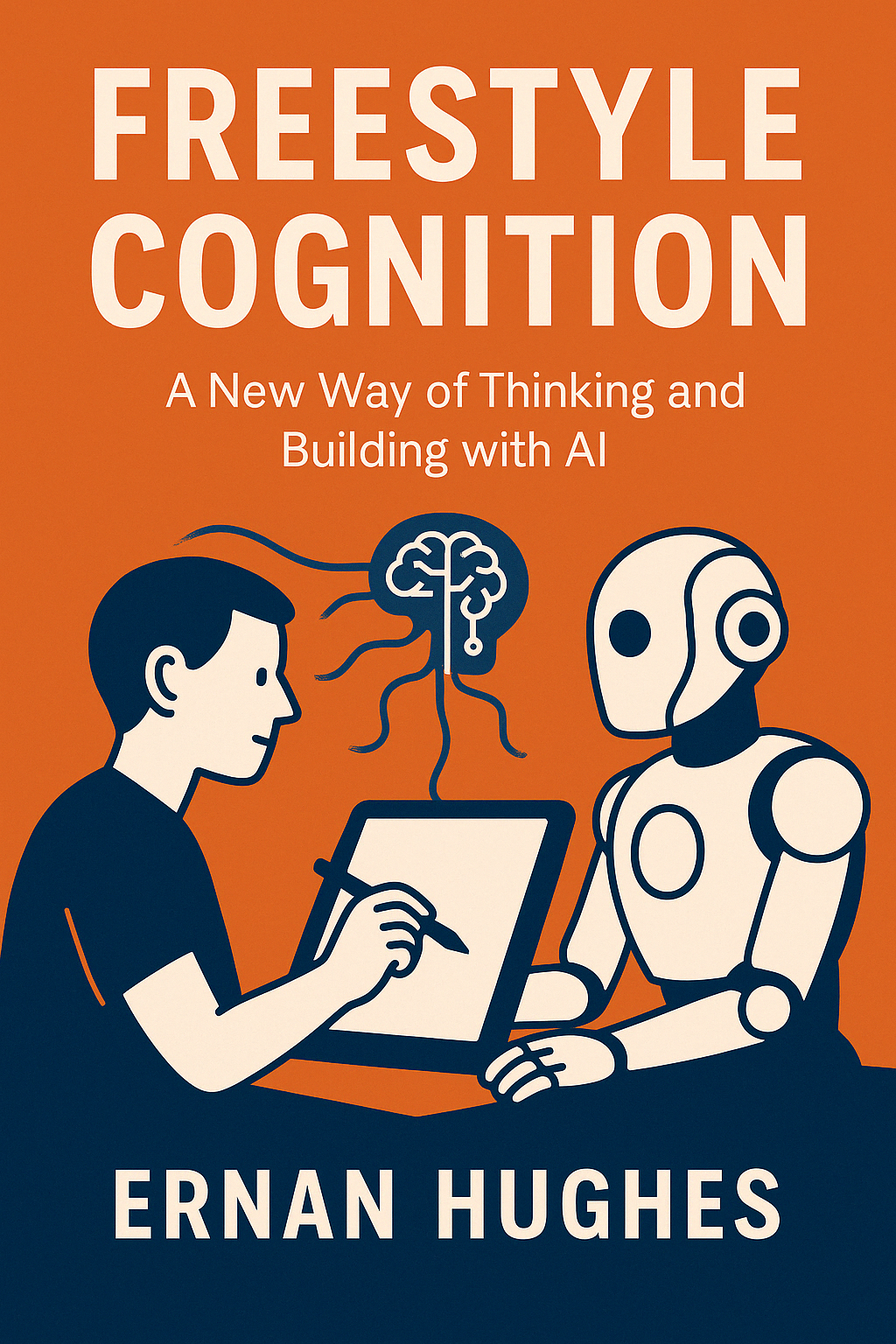
Freestyle Cognition
Think, create, research, write, and build with AI through open conversation, clear intent, structured reflection, iterative collaboration, and amplified creation.
Freestyle cognition is not prompt engineering.
It is not the search for the perfect instruction, and it is not simply asking an AI for an answer.
At its most useful, Freestyle Cognition is a way of thinking into the machine: getting your real thoughts into the conversation, making your intent visible, letting the AI reflect and expand what you mean, and then iterating until thought becomes something real.
This book builds that practice from first principles.
We begin with an experience many people have already had: you give an AI a rough idea, a half-formed thought, or a difficult task, and it returns something unexpectedly useful. The work suddenly becomes lighter. The idea becomes clearer. Something that was stuck begins to move.
The book calls that result Amplified Creation.
The recurring question throughout the book is:
How do you get more of what you actually mean into the interaction, keep your judgment in the loop, and turn an AI conversation into real work?
The process we will build
The basic shape is simple:
rough thought
    ↓
name the session
    ↓
state the goal
    ↓
speak freely
    ↓
AI reflects and expands
    ↓
check alignment
    ↓
explore alternatives
    ↓
apply a prompting technique or process
    ↓
build something real
    ↓
critique + edit + test
    ↓
crystallize the result
    ↓
reflect on the process
    ↓
rework / improve / continue
    ↓
Amplified Creation
The AI is doing a great deal of work inside that loop.
But the interaction is not automatic.
You still decide what matters, what is true to your intention, what deserves another pass, what should be rejected, and when the work is finished.
That distinction is the foundation of this book.
What this book is designed to teach
By working through the chapters, you will learn how to turn an ordinary AI conversation into a repeatable creative and cognitive process.
You will learn how to:
-
stop treating AI interaction as a sequence of isolated prompts;
-
use a session as a unit of focused work with a name, a goal, a process, and an ending;
-
speak or type freely enough that the AI can work with the full shape of your thinking rather than a compressed instruction;
-
use voice as a high-bandwidth interface for externalizing thought;
-
recognize the difference between expression and polish, and delay editing until there is something worth editing;
-
check whether the AI actually understands what you mean before allowing the work to drift;
-
use alignment loops to reduce the gap between your intention and the AI’s interpretation;
-
use structured prompting techniques such as ALIGN, GROW, GROWS, CRITIC, ROW, MARS, HOOK, VIBE, and MIRROR when the conversation needs more structure;
-
move between free conversation and deliberate process instead of choosing one or the other;
-
ask the AI to generate alternatives, expose assumptions, critique work, reflect on progress, and suggest better directions;
-
recognize the Sea of Elation: the danger of mistaking encouragement and agreement for evidence that the work is good;
-
build friction into the process through critique, review, testing, editing, and multiple perspectives;
-
offload effort to the AI without offloading authorship, taste, direction, or final judgment;
-
turn fuzzy ideas into structured, reusable artifacts through crystallization;
-
preserve sessions so unfinished work becomes a living archive rather than discarded conversation;
-
return to old work with new tools through the Rework process;
-
formalize freestyle cognition as a repeatable loop rather than relying on occasional lucky interactions;
-
use AI as a co-editor and apply a structured editing process before work is considered finished;
-
recognize the conditions under which Amplified Creation occurs;
-
apply the method to long-form writing, research, software development, planning, and other real projects;
-
use AI to inspect your own working process and surface patterns you might otherwise miss;
-
diagnose sessions that feel flat, unproductive, or overhyped; and
-
build a personal way of working with AI that becomes more effective as your experience, tools, and judgment improve.
The objective is not to become better at talking like a prompt engineer.
It is to become better at transferring what you mean into the machine, steering what comes back, and turning the interaction into something useful.
One process, built progressively
The chapters describe one practice becoming more deliberate, more structured, and more capable.
01  You've Probably Already Felt It
    Recognize the first moments of amplified creation and name the shift
    from asking for answers to thinking with the machine.

02  Learning to Talk to the Machine
    Introduce sessions, goals, alignment, structured interaction, and the
    first safeguards against shallow agreement.

03  Speak Freely, Think Clearly
    Use voice and unfiltered expression as cognitive interfaces, and learn
    how resonance loops turn rough thought into clearer thought.

04  Beyond Prompting
    Move from isolated prompts to prompting techniques that guide reflection,
    alignment, reasoning, iteration, and improvement.

05  Ghosted by the Machine
    Run a complete creative session using multiple techniques and experience
    freestyle cognition in motion rather than as theory.

06  Build Something Real
    Offload effort, reduce the gap between intent and interpretation, and
    turn conversation into a tangible result.

07  Rework
    Treat previous sessions as a living archive and use newer knowledge,
    CRITIC, ROW, and GROW to revive, merge, improve, or discard old work.

08  Applied AI
    Formalize the process:
    Describe → Expand → Reflect → Refine → Finalize → Loop Back.

09  The Editing Process
    Change the AI from co-creator to co-editor, apply quality checkpoints,
    use Council Review, and decide what is ready to crystallize.

10  Amplified Creation
    Name the phenomenon the earlier chapters have been approaching and
    examine what happens when thought, interaction, and execution align.

11  The Book You Were Born to Write
    Apply freestyle cognition to long-form creation through multiple passes,
    critique loops, restructuring, rewriting, and final judgment.

12  Research
    Turn curiosity and research papers into understanding, experiments,
    implementations, critiques, and new lines of inquiry.

13  Machine Coding
    Turn conversation into working software by constraining the environment,
    building modularly, testing, debugging, syncing, and polishing.

14  Awareness / Process Enhancement
    Let the AI inspect the history of the work itself, using reflective
    techniques to identify patterns, stalls, improvements, and breakthroughs.

15  When It Doesn't Work
    Examine the conditions where freestyle cognition falls flat, separate
    real application from empty conversation, and learn how to recover.

16  Upgraded
    Integrate the practice, return to the starting point, compare how your
    relationship with AI has changed, and begin using the method on your own.
The progression matters.
At first, the book asks you to express more.
Then it teaches you to align.
Then to structure the interaction.
Then to build.
Then to criticize, edit, and rework what was built.
Only after those mechanisms exist does the book fully name Amplified Creation and apply the process to larger domains such as books, research, and software.
Chapter 16 adds no new trick.
It asks whether the method has become something you can actually use:
idea
  ↓
conversation
  ↓
alignment
  ↓
process
  ↓
creation
  ↓
critique
  ↓
crystallization
  ↓
reflection
  ↓
better next attempt
The point is not one extraordinary session.
It is making better sessions repeatable.
The central principle
Language models are powerful because they can generate, reorganize, compare, explain, transform, and explore at extraordinary speed.
But there is always a gap between what you mean and what the AI believes you mean.
Freestyle cognition works on that gap.
What do I actually want?
        ↓
Have I expressed enough of it?
        ↓
What does the AI think I mean?
        ↓
Where are we misaligned?
        ↓
What should the AI do next?
        ↓
What came back?
        ↓
Is it actually good?
        ↓
What should change?
        ↓
Are we done?
That gives us one of the book’s main rules:
Do not optimize for the perfect prompt. Optimize the loop between intention, expression, understanding, creation, and judgment.
Or, more compactly:
You provide intent and judgment. The AI provides reach and effort. The conversation keeps the two aligned.
This is also why the book repeatedly returns to critique, editing, testing, and reflection.
A fluent response is not proof that the work is good.
A confident response is not proof that the AI understood you.
Praise is not validation.
The work still has to survive your judgment.
What you should be able to do after reading
The goal is not that you memorize every prompting technique in the book.
The goal is that working with AI becomes more deliberate and more legible.
You should be able to open a conversation and ask:
What am I trying to achieve?

Have I given the AI enough of my real thinking?

What does it believe I mean?

Where is the gap between my intention and its interpretation?

Should I keep talking freely or introduce more structure?

Which prompting technique would help here?

Are we exploring, deciding, building, editing, or reflecting?

What work can I offload?

What judgment must remain mine?

Are we generating alternatives or prematurely committing?

Is the AI agreeing because the idea is strong, or because agreement is easy?

What evidence says this result is actually better?

What needs another pass?

Has the result crystallized into something usable?

Should this session continue, stop, or become a future Rework session?

What did I learn about the work?

What did I learn about my own process?
Those questions are more durable than any specific model or interface.
They also make failure easier to diagnose.
Instead of saying:
The AI isn’t helping.
you can ask whether the problem is unclear intent, weak transfer, poor alignment, insufficient context, premature convergence, the wrong technique, shallow critique, missing validation, or simply the absence of a real goal.
That is a much more useful way to work.
You will also learn when not to use the full process
Not every task needs freestyle cognition.
If you need a translation, a short summary, a quick calculation, or a simple rewrite, one direct request may be enough.
The full process becomes valuable when the work is uncertain, creative, difficult to express, iterative, or large enough that your intention has to evolve while you work.
That includes:
-
discovering what you think;
-
developing an idea you cannot yet explain cleanly;
-
writing something substantial;
-
researching an unfamiliar subject;
-
building software;
-
revisiting unfinished work;
-
making a difficult decision;
-
debugging a process; or
-
turning a vague ambition into something concrete.
The method is not about maximizing the number of AI turns.
It is about using interaction where interaction earns its cost.
Who this book is for
You do not need to be a programmer.
You do not need to know prompt engineering.
You do not need a library of carefully optimized prompts.
You need a real question, project, problem, or idea and a willingness to put enough of your thinking into the conversation for the AI to work with it.
Writers can use the method to discover and refine what they want to say.
Researchers can use it to unpack papers, challenge assumptions, and turn understanding into experiments.
Developers can use it to move from intent to architecture, code, tests, debugging, and revision.
Anyone doing difficult cognitive or creative work can use it to make thought more visible, editable, and actionable.
What this book does not try to teach
This is not a catalogue of one-shot prompt tricks.
It is not a claim that every conversation with AI will produce a breakthrough.
It is not a method for surrendering judgment to the machine.
And it is not a promise that more AI automatically produces better work.
The book repeatedly introduces friction for exactly the opposite reason.
Alignment matters.
Critique matters.
Editing matters.
Testing matters.
Reflection matters.
Sometimes the right result is to revise.
Sometimes it is to rework.
Sometimes it is to discard the idea.
Sometimes it is to stop.
Freestyle cognition is valuable because the interaction can amplify what you bring to it.
That means your intent, knowledge, curiosity, taste, and judgment matter more, not less.
The promise
By the end of Freestyle Cognition, you should be able to begin with a rough thought and deliberately move it through a process:
express it, align it, explore it, structure it, build it, challenge it, refine it, crystallize it, and learn from what happened.
You should also be able to recognize the moment the book is ultimately trying to make repeatable:
Amplified Creation: when your intention and the machine’s capabilities combine to produce something clearer, faster, deeper, or more useful than you were able to reach through either a one-shot prompt or unaided effort.
The goal is not for the AI to replace your thinking.
The goal is to reduce the distance between thinking and making.
Once that distance becomes small enough, the machine stops feeling like a box you issue commands to.
It becomes part of the process through which ideas become real.
Chapters
You’ve Probably Already Felt It
Explore the concept of Freestyle Cognition—a new way of working where you speak freely to the machine, and it helps you clarify, structure, and build something greater than you could alone. This chapter introduces amplified creation and sets the foundation for a collaborative partnership with AI.
Learning to Talk to the Machine
Learn a simple, structured way to interact with AI that feels natural and effective. This chapter introduces the Session Template, a six-step process for focused collaboration, and explains how to avoid the trap of the 'Sea of Elation'.
Speak Freely, Think Clearly
Discover how using your voice with AI transforms your thinking. This chapter explores how speaking unlocks faster ideation, bypasses your inner editor, and creates a feedback loop with AI that leads to deeper clarity and breakthrough insights.
Beyond Prompting
Move beyond simple prompts to structured collaboration with AI. This chapter introduces prompting techniques as frameworks for real-time co-creation, featuring two powerful loops—ALIGN and GROWS—that transform AI interaction into a dynamic, self-improving dialogue.
Ghosted by the Machine
Experience a complete real-time freestyle cognition session as we co-write a pop-punk song using five core algorithms—ALIGN, HOOK, MARS, GROWS, and VIBE. This chapter demonstrates how structured dialogue transforms AI into a reflective, reasoning creative partner.
Build Something Real: From Conversation to Creation
This chapter marks the transition from reflective dialogue to active building. Learn how to close the gap between intention and execution, offload heavy lifting to AI, and crystallize your ideas into real, usable outputs—from blog posts to modular architectures to personal coaching systems.
Rework: Applying New Intelligence to Old Ideas
Discover how to revisit unfinished sessions, apply new prompting techniques, and finish what you started. This chapter introduces ROW, CRITIC, and the Rework workflow—turning your conversation archive into a living resource for building on past insights.
Applied AI: The Freestyle Cognition Framework
Formalize your AI collaboration with a structured, repeatable process. This chapter introduces the full Freestyle Cognition framework—a six-step session template that transforms raw ideas into refined outputs through iterative dialogue, prompting techniques, and intentional reflection.
The Editing Process: From Draft to Contribution
Master the art of refining your work with AI. This chapter introduces a 10-step editing system that transforms raw drafts into polished, reader-ready content. Learn how to use AI as a co-editor, run Council Reviews for multi-perspective feedback, and crystallize your work into something real.
Amplified Creation
Amplified Creation is the moment when human intent meets AI amplification to produce results that are faster, clearer, and more impactful than you could achieve alone. This chapter defines the concept, provides real-world examples, and introduces key principles like offloading, the second pass, and tracking breakthroughs.
Writing a Book with AI: The Four-Pass System
Learn how to write a book using the Freestyle Cognition framework. This chapter walks through the four-pass system—from breakout session to final clean read—showing how to collaborate with AI to transform a raw idea into a polished manuscript.
Research: From Paper to Pipeline with AI
Learn how to collaborate with AI to turn research papers into testable, reproducible working artifacts. This chapter modernizes the paper-to-pipeline loop around claims, assumptions, evidence, implementation boundaries, verification, and careful extension.
Machine Coding: Building Software with AI
Learn how to build functional applications through AI collaboration. This chapter updates machine coding for modern coding agents: intent, constraints, repository state, tests, verification, recovery, and small evidence-backed releases.
Awareness: Reflecting on Your Process with AI
Learn how to use AI to reflect on your own cognitive process. This chapter introduces the MIRROR prompting technique, and shows how to combine it with GROW and CRITIC to analyze your work patterns, identify blind spots, and surface moments of Amplified Creation.
When It Doesn’t Work: Troubleshooting Freestyle Cognition
What happens when the method doesn't click? This chapter addresses common criticisms, explains why Freestyle Cognition might not work for you, and offers practical remedies—including the 'Council of You' self-reflection exercise and the Harsh Critic prompt—to help you find your breakthrough.
Upgraded: The Beginning of Your Journey
The final chapter is not an ending but a beginning. This chapter recaps the tools and principles you've learned, offers a path forward, and invites you to reflect on your transformation—from passive AI user to active co-creator in the practice of Freestyle Cognition.
Appendix 01: Cheat Sheet
A comprehensive 100-point reference guide to Freestyle Cognition—covering foundational principles, the practice, interaction modes, psychological shifts, tools, metaphors, and example use cases. Your quick-start guide to thinking with AI.
Appendix 02: Is Freestyle Cognition Legitimate?
A detailed analysis using the full Freestyle Cognition process—ROW, GROW, and CRITIC—to evaluate whether the method is a legitimate extension of human cognition or a metaphorical framing. This appendix demonstrates the method applied to itself.
Appendix 03: Useful Prompts
A curated collection of ready-to-use prompts for every stage of the Freestyle Cognition process—from alignment and stand-up check-ins to planning, deep talk sessions, reflection, and tracking. Use these templates to stay in sync with the AI and amplify your creative flow.
Appendix 04: Prompting Techniques: A Reference Guide
A comprehensive reference catalog of the core prompting techniques used in Freestyle Cognition—from ALIGN and GROW to CRITIC, MARS, and VIBE. Each entry includes its purpose, use case, and guidance on combining techniques for maximum impact.
Appendix 05: References: Foundational Research
A curated bibliography of key research papers that informed and inspired the Freestyle Cognition methodology—covering Chain of Thought prompting, strategic coordination, bootstrapping reasoning, and answer verification.
Appendix 06: Example CRITIC Session: A Live Demo
A full transcript of a CRITIC loop in action—showing the three phases of Coach, Critic, and Journal. Use this as a template for your own reflective sessions with AI.
Appendix 07: Choosing the Right AI for the Job
A Spring 2025 guide to role-based model selection. Learn how to match specific AI models to specific roles—Editor, Emotional Reader, Technical Reviewer, and more—to build multi-model workflows that outperform any single system.
Appendix 08: Amplified Creation Moments: A Personal Log
A raw, live-recorded log of Amplified Creation moments from the writing of Chapter 10. This appendix captures the breakthroughs, realizations, and critical self-reflection that define when the process truly transforms—including the pivotal insight about building friction into the creative loop.
Appendix 09: Writing Fiction with AI: Tools and Workflows
A practical guide to AI-assisted fiction writing—covering the best tools (ChatGPT, Sudowrite, NovelCrafter, Claude), a step-by-step workflow from idea to polish, prompting tips, and real success stories. Written for authors who want to amplify their creativity without losing their voice.
Appendix 10: Prompting Techniques for Fiction Writing
A practical toolkit of prompting patterns for AI-assisted fiction writing—from Chain of Thought and Role-Playing to Continuity Checks and Marketing Copy. Learn how to offload effectively, maintain creative control, and co-create stories you're proud of.
Appendix 11: Amplified Log Template
A structured template for tracking and reflecting on your best freestyle cognition sessions. Use this log to capture breakthroughs, understand what led to amplified creation, and build a personal archive of peak creative moments.
Appendix 12: Machine Coding: Pre-Prompt Checklist
A practical pre-prompt checklist for defining your app before engaging AI. Use this guide to clarify data design, technical foundations, configuration, intelligence layers, embeddings, and input/output handling—ensuring your AI partner has everything it needs to build effectively.
Appendix 13: AI Hallucination Check Prompt
A diagnostic prompt to help you detect when the AI is hallucinating or out of sync with your project. Use this tool to assess hallucination risk and guide recovery actions—from resetting files to remodularizing or requesting a clean restart.
Appendix 14: Prompt Toolkit for Machine Coding
A reusable collection of prompts for the crystallization phase of AI-powered development—file polishing, test generation, documentation, and complexity reduction. Use these tools to clean up, test, document, and simplify your code before handoff or deployment.
Appendix 15: Paper Coverage Report: AI as a Co-Scientist
A detailed coverage report for the paper 'AI as a Co-Scientist: Hypothesis Generation and Evaluation with LLMs' (arXiv:2502.18864v1). This appendix documents what was implemented from the paper, what was extended, and opportunities for further research.
Appendix 16: Implementing AI as a Co-Scientist: A Research Case Study
A complete walkthrough of implementing the 'AI as a Co-Scientist' paper (arXiv:2502.18864v1) using DSPy, pgvector, Ollama, and PostgreSQL. This appendix documents the end-to-end development process—from paper review to scaffolded project—including agent logic, ELO ranking, grafting, and CLI tooling.