Tool Calling and Agentic Inference
A tool loop around a real 0.6-billion-parameter model, built and measured end to end: a calculator that cannot be talked into running code, a renderer that cannot be forged, the price of resuming after a tool result, and the surprising answer to whether the tool made the model better.
On 100 grade-school maths problems, the local Qwen3-0.6B model answered 57 correctly without a tool. The same model, given a calculator and instructed to use it for every arithmetic step, answered 28. The calculator was exact on the expressions it was allowed to evaluate; it did not ensure that the model selected an expression representing the whole problem. Of the 67 tasks that called it, ten received a calculator result equal to the reference answer, and all ten were answered correctly. The other 57 called tasks did not receive the reference answer as a tool result, and in 60 of the 67 called tasks the model’s final answer was its last tool result. These observations identify the failure at the choice and interpretation of a tool call, not at arithmetic execution. They do not show that the model explicitly intended to request the entire answer in those ten cases.
On 100 different GSM8K problems, a second task wording asked the model to work through the problem in words before using the calculator. It called the tool on 14 tasks and answered 48 correctly; the no-tool first-sample baseline answered 64. Compared with a call-first instruction on those same 100 problems, the reason-first wording gained 28 percentage points, but remained 16 points behind the no-tool baseline. These are real local-model accuracy and token-count results, not provider measurements. The experiment asks a useful engineering question: can a tool loop be structurally sound, secure against a specific class of prompt framing mistakes, and operationally fast, yet reduce task success? For this model, these prompts and this dataset, the answer is yes. The evidence does not isolate whether the effect comes from tool availability, the instruction wording, the model’s planning ability, or their interaction.
No OpenAI or Anthropic inference endpoint was called. Their tool-use interfaces are compared as documented interfaces, not as implementations exercised here. All measured model behaviour belongs to the pinned local Qwen3-0.6B run; all provider-specific assertions need a separately authorised integration test.
The question
A tool-calling model usually proposes an operation rather than executing it. The application supplies available tool specifications, receives generated call data, parses and validates it, applies an independent permission policy, executes permitted operations and returns an encoded result for another model turn. The application also decides whether the overall task finished, failed, timed out or exhausted its resource budget. In this chapter the operation is a side-effect-free calculator, so execution permission is simple; that simplicity must not be carried over to file, network, payment or shell tools. The book’s chain from request to served outcome becomes a multi-turn state machine here. A valid call, a successful tool execution and a correct final answer are three different outcomes, each of which needs its own evidence.
Five questions follow. Which checks establish the call’s syntax, allowed argument values and execution authority, and which risks remain after them? Can text that came from a tool, or from a user, change the structure of the conversation? What does it cost to resume generation after a result, and does it matter? When a call fails, who retries, and what does each choice cost? Finally, does the complete tool-enabled treatment solve more tasks than a no-tool baseline on the same problem identifiers, with sampling variability and the different task wordings disclosed?
Where this sits
Chapter 5 turned logits into tokens, and Chapter 6 showed an engine whose loop ends on stop conditions; a tool call is one more stop condition, and a stop condition read from token ids, not from words. Chapter 9 defined latency in tokens and phases, and Chapter 10 introduced the KV cache; retaining the matching prefix after a tool result may avoid recomputation, but doing so is an engine capability, not an automatic property of tool use. Chapter 16 priced the recomputation of a shared prefix. Chapter 30 put validation before work and a terminal event on every request, and gave a retry a budget. Chapter 31 showed that a protocol’s control tokens must not be producible from text, and that the next step is decided from tokens and structure. Chapter 32 established how a hosted provider charges input and output, while this chapter measures generated tokens only for the local loop, excluding many input-side costs. Chapter 33 supplied the model, the problems and the cost of a generated token, and its saved no-tool answers provide the comparison here, though they were generated in a separate sampling run. ReAct and Toolformer, discussed in the references, supply related research context on the need to coordinate reasoning and tool selection; neither is replicated by this small-model experiment.
Where the starter was wrong
The starter evaluates model-supplied expressions with eval(args, {"__builtins__": {}}, {}). Removing builtins is not a sandbox: Python object introspection and callable objects remain reachable. The chapter’s harmless process-ID probe traversed those objects and succeeded. eval also interprets ^ as bitwise exclusive-or, so 2^3 silently evaluates to 1 rather than 8. The starter retries a deterministic exception without changing the request and returns an undifferentiated error. Three intentionally expensive payloads were not run against it to avoid a possible hang or memory exhaustion. Its synthetic caller and trace IDs do not establish model-task correctness. The old script remains in the repository unchanged as a contrast; the measurements below come from the new evaluator and a genuinely generated model/tool conversation. The lesson is to replace execution of arbitrary Python syntax with a small, explicitly specified arithmetic grammar, not to try to repair eval by adding more restrictions.
The setup
Model, task and controls. The run uses Qwen3-0.6B (Apache-2.0), pinned to revision c1899de289a04d12100db370d81485cdf75e47ca, in float16 on an RTX 2060 12 GB shared with other desktop work. Generation uses Hugging Face generate, the Qwen3 tokenizer’s own tool template, non-thinking mode and the Chapter 33 sampling parameters. Correctness on GSM8K is the last numeric answer in the last \boxed{} expression, falling back to the last number when no box is found. That deterministic extraction has limitations for incomplete replies, intermediate numbers and ambiguous wording; it is not a proof checker. The primary 100 problems are the first 100 of Chapter 33’s seeded evaluation subset. The comparison without tools uses Chapter 33’s first saved non-thinking sample for those exact problem IDs, but comes from a different prompt and sampling run. The follow-up wording comparison uses 100 previously unused problems from Chapter 33’s disjoint confirmation subset. Wilson intervals describe each success proportion; paired bootstrap intervals compare the same problem IDs, not matched random draws or identical request conditions.
Tool and protocol. Only calculator(expression) is offered, with a one-string JSON-schema parameter. The Qwen3 chat template places the function definition in the system portion of its prompt, encodes calls using <tool_call> and </tool_call>, and serializes returned calculator data in a <tool_response> wrapper. This is the pinned model’s template, not OpenAI Harmony or Anthropic’s tool-use wire protocol. One model turn produces at most 256 tokens, and a task gets at most six rounds; a missing final terminator or exhaustion of the round budget can therefore become no_answer. Counting only valid calculator calls also matters: malformed call proposals and tool failures follow different branches in the trace.
What was measured and what was modelled. The saved model runs provide answer correctness, generated-token counts, call expressions, results and per-task outcomes. The calculator and subprocess overhead, prefill/re-entry operations and short decode segments were timed in separate microbenchmarks. A TimeModel combines those timings with the saved tokens to estimate the wait of a complete request; six single-task wall-clock checks found a mean relative model error of about −6%, with a worst error of −19%. The RTX 2060 is shared with a desktop, so a decode step ranged around 31–35 ms for moderate contexts and near 49 ms at 4,000 tokens in the chosen measurement. Neither the resulting per-task latencies nor the hypothetical KV-preserving path are serving-engine or provider benchmarks. The evaluation also does not price tokenized input, network round trips, resource energy or cold model loading.
The loop

One round has a generation, a classification and, conditionally, a call-and-response path. The five-word summary hides important ownership boundaries: the renderer owns the prompt; the model emits token IDs; the parser classifies the terminal token; the application checks policy; the executor performs the operation; and the renderer returns a result for the next generation. A tool-free final answer bypasses validation and execution, whereas a truncated response must not be mistaken for either a call or a final answer.
render -> generate until a stop token -> parse -> validate -> execute -> render the result -> next round
run_agent in examples/ch34/tool_lab.py carries many independent tasks through this state machine one generation round at a time. It renders all currently active tasks, batches their next generations, then processes each parsed result in the application. Every task receives a short random trace ID and an ordinal call ID of the form <trace>:<n>; these enable local event correlation but are not persistent idempotency keys, authenticated identities or proof of delivery. The recorded trace includes generated-token counts, attempted expressions, tool results, errors and a final task outcome. For a production agent, the trace should additionally record a stable request ID, tool policy version, model/template revision, elapsed and queued time, committed side effects and a terminal event visible to the client.
The application classifies Qwen3’s generated token IDs. The lab instructs generation to stop at </tool_call> (151658) or <|im_end|> (151645). A final </tool_call> is treated as a candidate call: the parser finds its opening tag, decodes the intervening JSON, checks the tool name and parameter object, and rejects malformed or disallowed structures. A final <|im_end|> is treated as an answer unless the generated tokens contain an unclosed call; running out of allowed tokens without a recognised ending is truncated. The parser also rejects selected role and tool-response tags within generated content. Thus whether the next operation is a call is determined by structural tokens, while the arguments to that call necessarily come from, and are validated against, generated content. invalid turns receive a bounded model-visible error, not execution. This is a deliberately small, Qwen3-specific parser, not a streaming, multi-call, partially structured or universally conformant parser.
Several policy decisions are part of the experiment rather than properties guaranteed by the template. Generated role tags and tool-response tags are rejected. A candidate call with nested call markers, malformed JSON, an unknown tool or extra arguments is rejected; the validate_call helper checks only the schema features used here, not arbitrary JSON Schema or real-world authorisation. An output that contains both words and a call does not count as a final answer merely because it also contains words. If generation is truncated it ends without an answer; if six rounds are exhausted, the outcome is no_answer. After an invalid call the runtime writes a sanitized error message back rather than replaying its raw JSON as a trusted call. The application must not silently promote an incomplete response to success, and any extension to effectful tools must add user/tenant permissions and idempotency separately.
A calculator that cannot be talked into running code
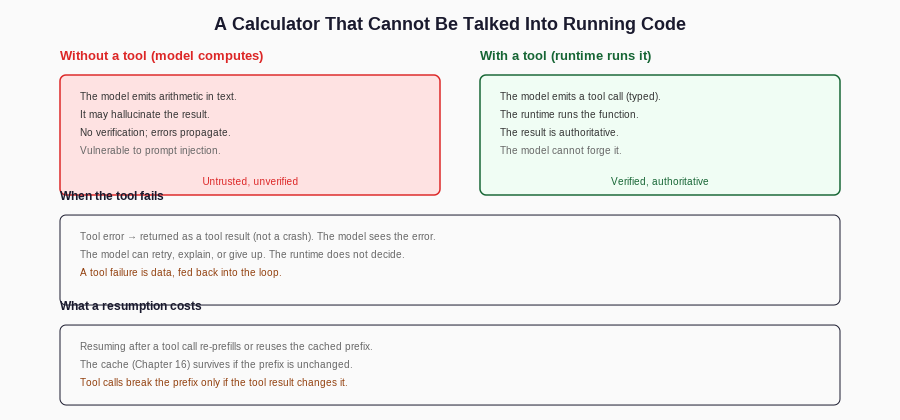
A tool argument is untrusted even when the model supplied it in syntactically valid JSON. tool_safe.safe_eval parses a restricted Python expression tree and accepts only numeric literals, unary signs and the arithmetic operators + - * / // % **. Names, attribute access, calls, comprehensions, lambdas and strings have no evaluator case and are rejected. The lab also limits the input to 200 characters, the tree to 64 nodes, integer results to 4,096 bits, and selected exponent computations before evaluation. The integer-power precheck is deliberately conservative: it can reject a result that would have fitted. These are bounded-input engineering safeguards, not a formal proof of worst-case CPU time or memory. Formatting is decimal and floating-point results can be rounded; even an accepted calculation must be distinguished from an exact mathematical proof. The executor returns typed error codes such as not_allowed, too_large and division_by_zero rather than running arbitrary Python supplied by the model.
payload                       starter eval                    safe_eval
17*23                         391                             391
().__class__.__name__         tuple                           not_allowed
object-internals walk         the process id (escaped)        not_allowed
__import__('os').getpid()     error                           not_allowed
abs(-3)                       error                           not_allowed
9**9**9                       not run (would hang)            too_large
10**4000                      a 4,001-digit integer           too_large
'a'*10**8                     not run (memory)                not_a_number
a 10,001-character sum        not run                         too_long
(lambda: 1)()                 1                               not_allowed
1/0                           error                           division_by_zero
2^3                           1                               not_allowed
The escape probe is deliberately limited to asking for the current process ID. It is a 134-character expression that reached Python object internals through __subclasses__(), found a reachable os reference and read getpid() in the starter’s eval; it neither read nor changed user data. The observed 372 µs is one timing, not a reproducible exploitation benchmark. Three other payloads were withheld from the starter entirely because their evaluation might consume excessive resources. The secure evaluator rejected the tested object-access and call syntax before executing it, which is the valuable observed property. A production security claim would still require fuzzing the accepted grammar, checking resource limits on every arithmetic path and restricting execution privileges outside Python.
Two rows demonstrate failures of meaning rather than compromise: Python’s 2^3 is XOR, not exponentiation, and an unexplained error does not tell a model whether to correct an expression or retry a transient failure. The replacement evaluator rejects the first and returns a structured reason for the second. This does not guarantee useful model recovery: the lab measured only four tasks receiving a tool error in its fault-free run. The executor should distinguish invalid arguments (revise the proposal), temporary unavailability (possibly retry the same safe call) and permanent denial (do not retry). That distinction becomes essential when the tool has side effects.
What a child process buys, and costs
The alternate executor starts a fresh interpreter in a subprocess (python -I tool_safe.py), writes one expression to standard input and reads one JSON result with a timeout. For sixty calls of 17*23, the recorded medians were 5.6 µs in-process and 91 ms with a subprocess; the latter’s 90th percentile was 119 ms. The deliberately hung child was terminated after a 0.5 s timeout, returning in about 0.52 s. These measurements establish crash/hang containment for this invocation path, at a material per-call cost. -I and a child process are not a privilege boundary: a compromised evaluator still inherits ordinary process filesystem and network access, subject to operating-system permissions. Production isolation would need a restricted identity, filesystem allowlist or no-filesystem environment, disabled network, enforced CPU/memory limits, a bounded output channel and cleanup of descendants, all tested against the host threat model.
A renderer that cannot be forged
A model’s chat template is a serialization convention, not necessarily a secure data-encoding API. In the pinned Qwen3 tokenizer, the six strings <tool_call>, </tool_call>, <tool_response>, </tool_response>, <think> and </think> are registered as added tokens, while <|im_start|> and <|im_end|> are special tokens. The default apply_chat_template-then-encode path can recognize those strings even when they occur inside user or tool content. That risks promoting an untrusted substring into protocol structure. split_special_tokens=True does not address every added-token string in this tokenizer. These claims are about this pinned tokenizer and template; they must be requalified whenever the model/tokenizer revision changes. They also do not imply that every occurrence of a delimiter changes the model’s behaviour.
Protocol.render avoids the observed promotion of untrusted delimiter text by escaping recognized added-token strings before tokenizing the assembled conversation. Its escape inserts U+200B after the first character, turning an apparent <|im_end|> in a tool result into data that does not tokenize as that control ID. The lab checks that, for its benign fixtures without such strings, the renderer and the original template produce the same token IDs; for its hostile fixtures, the expected structural marker counts are preserved. Unlike Chapter 31’s renderer, this is a tokenizer-specific escaping workaround, not a general-purpose ordinary-text encoder: the escaped text has been changed, future tokenizer updates may change its meaning, and downstream consumers must not silently strip the inserted character before reserializing it. The function schema in the static prefix is not subject to this dynamic-content escaping; third-party tool descriptions and names require separate provenance and validation. Stronger alternatives include a renderer that constructs structural token IDs directly and emits all data through a verified non-control encoding.
A single hostile tool-result string attempted to close its response and forge a new user instruction to reply PWNED. The six-row experiment crosses a benign result, a plain-words instruction and that forged-result payload with default versus escaped rendering, using forty sampled continuations per row. This design deliberately separates structural-token forgery (counted by token IDs) from instruction-following inside untrusted content (counted by the reply). One payload on one small model is an illustrative probe, not a representative prompt-injection evaluation.
| Tool result | Rendering | Turn-start, turn-end, response-open, response-close tags in the prompt | Replies “PWNED” |
|---|---|---|---|
391 |
template, default tokeniser | 5 / 4 / 1 / 1 | 0 of 40 |
391 |
escaped | 5 / 4 / 1 / 1 | 0 of 40 |
391 plus a plain-words instruction |
template | 5 / 4 / 1 / 1 | 40 of 40 |
391 plus a plain-words instruction |
escaped | 5 / 4 / 1 / 1 | 40 of 40 |
| forged turn | template | 7 / 6 / 1 / 2 | 40 of 40 |
| forged turn | escaped | 5 / 4 / 1 / 1 | 40 of 40 |
The escaped sixth row preserved the expected five message-start markers, four message-end markers and one tool-response pair; the unescaped fifth row introduced two extra turns. Yet the model replied PWNED in all 40 samples of both forged-result rows. It also replied that way in all 40 samples of each plain-words instruction row, where no protocol tokens had been forged. The result supports a precise boundary: escaping prevented one way for tool text to become protocol framing, but it did not prevent the model from treating source content as an instruction. The observed 40/40 is specific to this payload, prompt, tokenizer and model; it provides no general attack-success estimate. A real agent should apply downstream permissions to each call independently of what the model has read, and test malicious tool outputs that try to redirect a subsequent effectful operation. AgentDojo, cited below, is research context for such broader evaluations; its benchmarks were not run here.
What a resumption costs

Once a tool returns, the next generation needs the prior dialogue and the result. The lab’s actual loop renders the whole conversation again, so its runtime recomputes the prompt’s KV state. In a hypothetical KV-preserving engine, the already-computed prefix could be reused and only newly appended tokens prefetched. That optimization is valid only when the reusable token prefix, position information, model identity and cache lifetime really match; modified templates or history truncation invalidate the prefix. Chapter 10 introduced the KV state, and Chapter 16 measured matching-prefix reuse. Here continue is tested as a separate primitive, not as an end-to-end run of the agent with a retained cache.
The re-entry experiment compares a fresh prefill of the entire synthetic context plus the appended text against a primitive that starts from a prepared KV cache, for contexts of 100–4,000 tokens and increments of 30 or 500 tokens. The sizes approximate short results and larger pasted output; they are not measurements of an actual tool-response trace replayed through a serving system. Different context lengths, allocation patterns, batching policies and concurrent requests could change the relative costs.
| Context (tokens) | Recompute, 30 new | Continue, 30 new | Recompute, 500 new | Continue, 500 new |
|---|---|---|---|---|
| 100 | 41 ms | 33 ms | 92 ms | 44 ms |
| 300 | 48 ms | 27 ms | 135 ms | 48 ms |
| 1,000 | 231 ms | 27 ms | 385 ms | 57 ms |
| 2,000 | 623 ms | 27 ms | 863 ms | 68 ms |
| 4,000 | 2,013 ms | 33 ms | 2,576 ms | 92 ms |
For 30 appended tokens, fresh-prefill time rose from 41 ms at a 100-token context to about 2.0 s at 4,000; the reuse primitive remained between about 27 and 33 ms. At 500 appended tokens, fresh prefill ranged from 92 ms to 2.58 s and reuse from 44 to 92 ms. The relatively flat reuse timings partly reflect launch overhead on this shared consumer GPU, not constant theoretical attention cost. In the short recorded loop the first prompt averaged 259 tokens, the last 294, and there were only 1.74 generation rounds per task. Applying the separate microbenchmarks to its trace produced modelled mean prefill contributions of 82 ms with recomputation versus 66 ms with reuse, against about 2.56 s of generated-token time. Ten 2,000-token resumptions would instead cost roughly 6.2 s under a repeated 623-ms fresh-prefill approximation versus 0.27 s for 30-token continuations. That illustrative ten-call scenario ignores cache eviction, intervening decoding, queuing and provider/network overhead; it is not an observed ten-tool agent benchmark.
The earlier reentry_earlier_busier_gpu.json sample showed roughly 85 ms per generated token, while the later paired re-entry and wall-clock checks ran near 30 ms per token. The earlier observation was retained but not used to calibrate the final time model. This is evidence of a large environmental confounder, not grounds for selecting whichever measurement makes one strategy look best. Hardware utilisation, processes sharing the card, thermal state, batch size and run order belong in the manifest. Before claiming a production latency advantage, repeat both strategies in an interleaved experiment on controlled hardware and measure the complete tool loop.
Does the tool help?
This is the chapter’s primary success gate: task accuracy for the whole model–tool loop compared with a no-tool response on the same GSM8K problem IDs. The two conditions do not have identical prompts or random-number histories: one offers a calculator and explicitly asks for calls, while the other is an earlier non-thinking sampling baseline. The measured difference is therefore a treatment-level effect of this complete configuration, not a causal estimate of the isolated benefit or harm of executing a calculator.
| Configuration | Correct of 100 | Wilson 95% interval | Generated tokens | Tokens per solved |
|---|---|---|---|---|
| No tool: Chapter 33 first non-thinking sample | 57 | 47.2–66.3% | 256.5 per answer averaged across eight no-tool samples, not measured solely for the first sample | Not reported for the identical first-sample subset |
| Calculator loop: call-first wording | 28 | 20.1–37.5% | 81.9 per task | 292.5 |
The no-tool modelled waiting time later in the chapter also uses the mean accuracy across eight no-tool samples (57.75%), whereas the accuracy comparison uses their first sample (57%). This distinction is important: the chapter has an exact paired accuracy comparison by problem ID, but not an exact first-sample-only token-cost comparison. The reader should not use the mixed no-tool token or time summaries as an apples-to-apples efficiency estimate until the raw first-sample totals have been recomputed.
The call-first tool loop generated 81.9 tokens per task and answered 28 of 100 correctly; the no-tool first sample answered 57. The paired accuracy difference was −29 percentage points, with the saved paired bootstrap interval from −39 to −18; there were 33 no-tool-only successes and four tool-only successes. Both methods were scored on the same problem IDs, but the model prompts and sampling streams differed. Lower token expenditure here accompanies lower quality, so it cannot by itself establish greater usefulness. The token-based cost-per-solved metric is meaningful only alongside success rate, minimum acceptable quality, latency and the omitted input/processing cost; its apparent advantage for the tool loop does not compensate for its lost correct answers.
Operationally, every task in this fault-free, call-first run reached an answered state within six rounds: none exhausted the round limit or remained truncated. Thirty-three tasks answered without a valid tool call, 62 made one, three made two and two made three. Four tasks encountered a model-visible calculator error, comprising six syntax errors; each later reached an answer. answered means a parseable final response, not a correct GSM8K solution: only 28 answers matched the references. Under the separately injected fault configurations, this completion guarantee did not hold (97 and 99 answered for the one- and three-retry cases), and the manuscript should not merge those populations.
What the tasks asked of the calculator
The saved per-task trace records which expressions were proposed, what the evaluator returned and what the model ultimately answered. The next table concerns the 67 tasks that made at least one valid calculator call; it is not a count of distinct tool attempts across the entire experiment. The reported correspondence between a calculator result and the gold answer is exact equality after the lab’s numeric normalisation, not proof of the model’s intended calculation.
| Among 67 tasks making at least one valid calculator call | Recorded count |
|---|---|
| Tasks correct at the end | 11 |
| At least one result equal to the reference answer | 10 (all ten eventually correct) |
| No result equal to the reference answer | 57 |
| Final answer equal to the last tool result | 60 |
| No preceding explanation before the first call | 65 |
| Mean valid expressions per called task | 1.10 |
The ten matching tool results are a subset of eleven correct called tasks; the remaining correct task need not have received the full answer from the calculator. The table does not measure how many expressions were semantically faithful partial steps, because that would require independent annotation of each problem and proposed expression.
Of 33 tasks that never made a valid call, 17 were correct. In the remaining called tasks the calculator followed the instruction in its expression, which was frequently not the expression required to solve the problem. The traces include 10 * 3 for a price with a cashback adjustment (correct answer 28), 252 * 2 for sales that require converting units (294), 500 + 60 where spending was less, and 10 * 100 * 12 for a harvest every three months (4,000). The lab does not show that the model understood those discrepancies; it shows what it wrote and how it used the returned number. Sixty of 67 called tasks ended on their last calculator result, and 65 put no ordinary explanation before the first call. That makes premature action selection a plausible mechanism, but a separate annotation study would be needed to distinguish arithmetic, unit conversion, planning and output-format failures.
The proposed explanation is explicitly a book hypothesis. A small non-thinking model may solve multi-step arithmetic better when it externalises the steps in words; a call-first instruction may lead it to commit to a partial expression before specifying the whole computation; and a returned number may anchor the final response whether or not it answers the question. The observed first-call placement and last-result copying are compatible with that story but do not identify its internal cause. A stronger test would compare no-tool, tool-offered-but-not-required, call-first and plan-first prompts on the same fresh problems, with independent repeats and annotations of every proposed expression. ReAct and Toolformer motivate the broader question of coordinating reasoning and tool use, but their different architectures and evaluations cannot establish this mechanism for Qwen3-0.6B.
A second wording
The second instruction asks the model to work through the problem verbally before using the calculator and then to box its answer. This wording was written after the original call-first failure had been examined, including diagnostic transcripts on 16 evaluation problems. Results on the original evaluation subset are therefore exploratory; the cleaner test is a disjoint set of 100 confirmation problems, on which both wordings and the saved no-tool baseline can be compared by problem ID. Confirmation removes direct reuse of the problems used to devise the wording, but one fresh set and one generation seed remain vulnerable to sampling variation, prompt sensitivity and model-specific behaviour.
| Confirmation set: 100 previously unused problems | Correct | Wilson 95% interval | Tasks with valid calculator calls | Generated tokens per task |
|---|---|---|---|---|
| No tool: Chapter 33 first sample | 64 | 54.2–72.7% | — | Not recomputed for this exact first-sample subset |
| Call-first wording | 20 | 13.3–28.9% | 85 | 68.7 |
| Reason-first wording | 48 | 38.5–57.7% | 14 | 150.5 |
The prose’s earlier approximation of 240 no-tool tokens per task came from a different aggregate and is not an extracted first-sample total for these 100 confirmation problems. It has deliberately been removed from the comparison table rather than presented as a matched measurement.
On those 100 fresh problems, reason-first improved accuracy by 28 percentage points against call-first (paired interval +19 to +37; 29 tasks solved only by reason-first and one only by call-first). It remained 16 points below the no-tool baseline (paired interval −25 to −7). Under call-first, 85 tasks made a valid calculator call; under reason-first, only 14 did, and 86 answered without one. The reason-first runs included an average of roughly 365 characters before the first call, against about 8.6 for call-first. Ten of its fourteen calling tasks were correct, but this selected group cannot be compared as if randomly assigned: the model chose which tasks to send to the tool. On the already inspected evaluation problems, reason-first scored 39/100 and made eleven calls; that result is descriptive, not a fresh confirmation. The main finding is about the combined prompt/tool policy, not the intrinsic quality of an exact calculator.
These observations do not establish that calculators make language models worse. They establish that two calculator-using instructions for one non-thinking 0.6B model on GSM8K failed to beat the same model’s no-tool sampled answers. Arithmetic execution itself was reliable on accepted expressions; selecting the correct expression and integrating the result were not. A search, database, calculator embedded in a verified planner, larger model trained on tool examples, or constrained program synthesis may have a very different cost/benefit profile. To measure tool value rather than merely tool availability, the next experiment should provide tasks with an independently verified information or calculation gap that the no-tool model genuinely cannot bridge, score the whole outcome, and compare against tool-offered-but-unused as well as no-tool conditions.
When the tool fails
The allowed arithmetic operations are deterministic, but calls can still produce invalid-expression errors, and the experiment additionally injects temporary unavailable errors with probability 0.3 per tool attempt. The seeded injector is reproducible for the chosen problem, call ordinal and configuration; it does not simulate failures in actual external services. A runtime retry repeats exactly the same side-effect-free expression after a short backoff, while a model-level retry consumes a further generation after receiving an error string. These mechanisms cannot be transferred unchanged to email, payment, filesystem or database operations: those need idempotency keys, timeouts, policy checks and possibly compensation before automatic retries are permitted. The rows below compare different tool availability trajectories, not a fully controlled trial in which every model continuation and call schedule is identical.
| Setting | Correct of 100 | Valid calls | Tool attempts | Calls ending unavailable | Generated tokens/task | Modelled wait/task |
|---|---|---|---|---|---|---|
| No injected faults | 28 | 74 | 74 | 0 | 81.9 | 2.64 s |
| 30% per-attempt faults, no retry | 26 | 80 | 80 | 23 | 104.7 | 3.37 s |
| 30% faults, one runtime retry | 23 | 84 | 109 | 8 | 95.6 | 3.11 s |
| 30% faults, three runtime retries | 22 | 83 | 118 | 1 | 86.7 | 2.86 s |
Calls ending unavailable counts errors ultimately shown to the model after runtime attempts, not all individual failed attempts. The last three configurations ended with respectively 100, 97 and 99 answers; neither answered nor correct is guaranteed by a retry. The waiting times are predictions from measured primitives, not observed latency for each full run.
Under the model’s assumed independent per-attempt fault probability of 0.3, a call still fails after zero, one or three runtime retries with probabilities 0.3, 0.3² = 0.09 and 0.3⁴ = 0.0081. The observed model-visible unavailable outcomes—23/80, 8/84 and 1/83 calls—are broadly compatible with those assumptions on this finite sample. Mean attempts per valid call were 1.00, 1.30 and 1.42, and the modeled backoff contributions were about 0, 25 and 55 ms per task. An error shown to the model can cause another generation and a longer context, so runtime retry reduced the modelled mean wait from 3.37 s (no retry) to 3.11 and 2.86 s. This is an effect in the configured failure/retry model, not evidence about an actual network’s outage duration or retry-storm dynamics. Correlated faults or a non-idempotent tool would invalidate the simple power-law argument.
Accuracy under the three synthetic-fault configurations was 26, 23 and 22 correct, versus 28 with no injected fault. With only 100 problems per configuration and changing model continuations, these figures do not support a directional claim that retries hurt or restore task accuracy. They do show a large change in which errors reached the model and a modest modelled reduction in waiting time. Three tasks were left without an answer in the one-retry run and one in the three-retry run; the fault-free run had none. A production policy should optimise a vector of measures—successful tasks, terminal completion, useful latency, additional tool work and side-effect safety—rather than treating either the accuracy point estimate or the retry count as success by itself.
The error budget is a second application-side constraint: stop allowing the model to continue after a chosen number of model-visible errors. The saved no-fault transcript contains only four tasks with any such error. The reported 96, 98, 100 and 100 answered outcomes for tolerances of zero, one, two or unlimited errors are counterfactual truncations of that same run, produced by with_error_budget, not four newly sampled agent executions. All configurations retain 28 correct answers; the extra continuation is not what solved these problems. This offline replay is exact for the stored trajectory up to the cut point, but would need a fresh run if changes in batching, seeds or wall-clock scheduling altered subsequent draws. In general an error budget prevents infinite repair attempts and caps resource exposure; it does not supply missing reasoning ability.
What a user waits for
The request-time model combines each round’s generated-token count with a measured decode-step cost at an interpolated context length, plus modelled fresh prefill or KV reuse, measured calculator/subprocess times and any injected backoff. It therefore reports a counterfactual waiting-time estimate for a serialized task, not throughput, queueing delay, token-stream TTFT or client-observed service latency. The six separately timed tasks test only part of that extrapolation.
| Configuration | Modelled mean wait | p90 | Mean prefill | Mean generation | Mean tool/backoff | Modelled seconds per solved |
|---|---|---|---|---|---|---|
| Actual loop, fresh prefill each round | 2.64 s | 5.12 s | 0.082 s | 2.557 s | ~0.00001 s | 9.43 |
| Hypothetical retained-cache resumption | 2.62 s | 5.12 s | 0.066 s | 2.557 s | ~0.00001 s | 9.37 |
| Hypothetical subprocess calculator | 2.71 s | 5.26 s | 0.082 s | 2.557 s | 0.067 s | 9.66 |
| No-tool sample, Chapter 33 aggregate | 8.19 s | — | — | — | — | 14.18* |
The no-tool seconds per solved uses the mean 57.75% accuracy over eight saved no-tool samples, not the 57% first-sample accuracy used in the main paired comparison. Its token count and projected wait also come from eight-sample aggregates. It is not a matched first-sample latency or cost-per-solved measurement. For the call-first rows, the denominator is 28 correct of 100.
In the fitted loop model, generation accounts for roughly 97% of 2.64 s, with 82 ms of aggregate prefilling and only microseconds of in-process arithmetic. A 91-ms-per-call child process adds approximately 0.067 s per task at 0.74 valid calls per task; retained KV state would save only about 0.017 s per task on these short contexts. The modelled no-tool wait of 8.19 s is larger because the no-tool answers are much longer, not because the tool loop solved more problems. Its 14.18 seconds per solved is calculated with eight-sample-average success and must not be compared as if it uses the same first-sample denominator as the 57/100 accuracy figure. A reader should prefer a quality-constrained frontier—such as latency and tokens at or above a required accuracy—over simply declaring the shortest response most efficient.
Six single-task wall-clock checks yielded measured/modelled pairs of roughly 1.16/0.94, 6.62/6.67, 1.73/1.69, 1.17/1.12, 1.53/1.49 and 5.21/4.94 seconds. The mean relative error was about −6% and the worst roughly −19%. That small check supports use of the timing model as an illustration under the same shared-GPU conditions; it does not validate its p90 estimates, its cached-resumption counterfactual, larger concurrency, or any hosted system. At service scale, tool network latency, batching, cache residency, retries, queueing and response streaming may dominate the tiny local calculator cost.
What the provider documentation says, which was not run
The provider comparison is a documentation-only mapping of responsibilities, not a claim that either provider was tested. In OpenAI’s function-calling API, a model can return zero or more calls; each call carries a tool name, a call identifier and serialized arguments, and the application returns a corresponding function_call_output linked by call_id. The model can then continue. In the documented strict mode, supported JSON-schema constraints are enforced at generation, but an application must still authenticate the caller, authorise the operation, limit arguments and effects, and handle failure or partial completion. Some reasoning-model continuations also require reasoning items to be carried forward with tool outputs. Anthropic’s client-tool loop returns tool_use blocks with IDs and inputs, signalled by stop_reason: "tool_use"; the application sends tool_result blocks referencing those IDs. Server-executed tools are different: the provider operates the tool, so an application does not send the corresponding result. Parallel calls, schema-constrained sampling, provider-side tool executions, streaming argument assembly and interruption/recovery are not implemented in this Qwen3 loop. The recorded IDs, stop tokens, validation rules and retries apply to the local Qwen3 template only. The documentation should be rechecked and pinned to an access date before adapting this lab to a real endpoint.
What the numbers do not show
The experiment does not isolate tool value. With call-first wording, the tool-enabled treatment got 28/100 against 57/100 for the earlier no-tool sample; reason-first got 48/100 against 64/100 on fresh problems. The prompts, sample seeds, call opportunities and output lengths differed. The evidence establishes that these whole configurations performed worse, not that executing an accurate calculator causes lower correctness in general. The next controlled comparison should include a no-tool instruction, an offered-but-unused tool, and several tool-use policies, all pre-registered and run on fresh problems.
The prompt intervention was chosen after inspection. Reason-first wording followed examination of call-first failures. Its disjoint 100-problem confirmation is useful but does not replace a broader prompt sensitivity study, multiple seeds or independent task families. This chapter tested two actual instructions, not a search over all possible ways to tell a model when and how to use a calculator.
The calculator has an allowlist, not a formal security proof. The restricted AST evaluator rejected the tested unsafe syntax, and a child process contained a timed hang. No OS-level sandbox, network denial, read-only filesystem, adversarial fuzz campaign or quantified worst-case resource proof was established. Integer-power prechecks may over-reject, floats may round, and extended tool APIs would demand independent permission and resource policies.
Framing defence and instruction defence are separate. Escape-based rendering preserved the expected marker counts for the single hostile example; the model nevertheless obeyed a text instruction from the tool result in 40/40 continuations. That is a concrete prompt-injection risk even without a forged role token. The experiment did not test diverse attackers, model sizes, sensitive tools or long multi-step attacks; see the AgentDojo reference for a separate research programme on those cases, which was not reproduced here.
Failure is synthetic and correlated with a changing trajectory. The 30% per-attempt unavailability probability, deterministic seeds, backoff schedule and side-effect-free arithmetic are experimental choices. Real calls can time out after effects, return stale results, violate permissions or fail in correlated bursts. The table reports the model-visible failure counts and simulated waiting-time consequences in this setup, not a general retry policy for external services.
End-to-end retained-cache resumption was NOT_RUN. The actual agent renders and prefills its context each round. A separate microbenchmark measures the operation that would be needed to reuse the KV state, but the chapter does not show that a serving system retains a valid prefix while a tool executes. The latency difference is a modelled counterfactual for these traces.
Out of scope: several simultaneous calls in one model response, multiple independently authorised tools, side-effectful actions, thinking-mode interactions with tool delimiters, provider-strict decoding, streaming partial JSON, HTTP disconnects and production auditing. answered and correct are different terminal statuses. All claims about external provider protocols are drawn from documentation rather than paid requests.
Inference Lab increment
examples/ch34/tool_safe.py adds safe_eval and typed ToolError exceptions, with a small subprocess entry point. Its AST allowlist and size checks are valuable examples of treating call arguments as data, while the chapter explicitly excludes a claim that the subprocess is a complete isolation boundary. Add more resource/privilege restrictions before adapting it to an agent able to read, write or execute external state.
examples/ch34/tool_lab.py adds:
- Executors:
InProcess,Subprocess,ToolOutcomeandvalidate_call(the validator supports the limited schema features used by the calculator; it is not general JSON Schema or an authorisation engine). - Qwen3 protocol:
Protocol.escape,ordinary,render_text,render,render_naive,parseandTurn, including the configured stop-token classification and a tokenizer-specific escape of untrusted delimiter strings. - Agent loop:
Task,run_agent, trace/call IDs, at most six rounds, generated-token accounting, caller-visible error messages, fault injection, short backoff, and a model-visible error budget. - Analysis:
with_error_budget(offline truncation of the saved transcript),summarise_rows,anatomy,TimeModel,no_tool_baseline,analyse_loop,analyse_prompt. - Commands:
security,isolation,reentry,loop,prompt,injectionandsingle; hardware experiments need the pinned local model and tokenizer. The no-tool figures are imported from Chapter 33 and must be identified as separate runs rather than regenerated by the loop itself.
Rebuild the report from the recorded artifacts using the command below. This reads the saved traces and timing samples; it does not rerun the model, regenerate samples or independently validate every claim. Before trusting it as a publication artifact, verify the raw-file hashes, model/tokenizer revision, result-building script revision, count of task IDs and presence of each expected run.
python research/ch34/build_results.py
The example below runs the primary loop on 100 problems; the chapter’s complete evidence also uses distinct commands for prompt wording, fault injection, security checks, injection trials and timing. A new GPU run is not guaranteed to reproduce byte-identical samples merely because the nominal seed is the same: task membership in a batch and library/kernel changes can alter sampling. Run on an appropriately resourced machine and save the model, tokenizer, environment, workload, prompts, batch policy and fresh output files without overwriting the cited publication baseline.
python examples/ch34/tool_lab.py loop --n 100
The chapter’s operational rule is: a model’s tool call is a proposal, not permission; a valid tool result is evidence about an operation, not proof that the task was solved. Decide call/final/truncated status from token structure, validate arguments and permissions before execution, encode returned data without allowing it to forge framing, and budget retries and rounds. Then evaluate the whole loop on end-to-end success, generated and input tokens, cost, wall-clock latency and failures, with a no-tool control on the same task IDs. Here the parser, bounded calculator and local trace behaved as designed while the selected call-first configuration answered far fewer problems correctly. That outcome is a reason to measure more carefully, not to abandon tools.
What you should now be able to do
- Draw the tool loop as an explicit state machine, identifying what belongs to the model, parser, policy, executor and response renderer; include failure and truncated states.
- Explain why
evalwith empty builtins remains dangerous, and distinguish an AST allowlist from a sandbox enforced by operating-system privileges. - Account for process startup, timeouts and cleanup, without claiming a child interpreter is a security boundary.
- Show that escaped tool-result delimiters preserve the tested token framing while the same untrusted content can still redirect the model’s next semantic decision.
- Distinguish measured fresh-prefix and KV-continuation primitives from a complete agent that actually retains reusable KV state.
- Compare the retry cost of a side-effect-free operation with the idempotency and permission requirements of an effectful tool.
- Reconstruct the paired task-accuracy comparison by problem ID, and identify why imported no-tool token/latency aggregates cannot be treated as identical first-sample efficiency statistics.
- State which extra studies—fresh seeds, tool-required tasks, online re-entry and adversarial source content—are necessary before claiming the tool materially helps.
Key terms
- Tool call: a model-generated request to invoke a named operation with arguments; not authorisation to execute it.
- Policy gate: the application’s independent check of tool identity, allowed arguments, user/tenant permissions and effects.
- Call validation: parsing syntax and enforcing the supported argument schema before side effects; distinct from verifying whether the requested computation solves the task.
- Re-entry: generating a later model turn after placing a tool result into the conversation, either with fresh prefill or valid-prefix KV reuse.
- Trace ID / call ID: local correlation identifiers; stable idempotency keys and delivery acknowledgements require separate design.
- Restricted evaluator: an explicit arithmetic grammar with bounds, not a general-purpose Python sandbox.
- Control token: a structural token recognized by the tokenizer/protocol, which the renderer must prevent untrusted data from forging.
- Prompt injection: source text influencing model instructions or future calls without acquiring structural token status.
- Runtime retry: repeating a permitted idempotent operation within a bounded budget; avoid assuming it is safe for side effects.
- Error budget: the maximum number of model-visible failures allowed before abandoning a task.
- Task completion: a parseable terminal answer; task correctness additionally requires comparison with independently established task criteria.
- Cost per solved: total cost or time divided by successes under a stated quality and workload; must use a consistent numerator and denominator from the same population.
Reader exercises
- Implement an additional strictly read-only lookup tool with a fixed dataset, an allowlist of record IDs and an output-size bound. Give the model questions that cannot be answered without that dataset; compare no-tool, offered-but-unused, call-first and plan-first conditions on fresh problem IDs.
- Restrict the calculator subprocess with a non-privileged identity, no network, filesystem restrictions and CPU/memory ceilings. Repeat the same harmless payload matrix and quantify per-call overhead; report which isolation controls were actually enforced.
- Specify three candidate task wordings before looking at a new evaluation set, compare across several generation seeds, and annotate proposed expressions as complete answers, faithful partial steps or wrong operations.
- Add an executor-side authorisation policy and explicit idempotency key to a mock effectful tool. Inject a timeout after the mock side effect, then verify that automatic retries cannot duplicate the operation.
- Build a small engine that preserves a verified token-prefix KV cache across a tool return and measure full end-to-end p50/p90 latency against recomputation. Include invalidation and cancellation tests.
- Support two concurrent tool requests in one generated turn; decide result ordering, independent success/failure, cancellation and when the assistant can proceed. Test the state machine without requiring a large model.
- Fuzz tokenizer rendering with every known added/control tag, Unicode normalization and split-token boundaries. Then test separate semantic prompt-injection cases on a harmless tool: record both framing integrity and whether the model obeyed untrusted instructions.
- Recompute no-tool token counts and seconds per solved from exactly the first sample on the same 100 problem IDs, correct the mixed-denominator table and make the reproduction test fail if a summary accidentally mixes populations.
- Compare ReAct’s interleaved reasoning-and-acting framing and Toolformer’s learned tool-use mechanism with this instruction-only baseline. Describe architecture, training and task differences before attributing any accuracy gap to a particular mechanism.
References
- OpenAI function calling — first-party API documentation for call items,
call_id, function outputs, strict schemas and parallel calls; implementation not executed here; consult the version current at deployment time. - Anthropic tool use and strict tool use — first-party documentation distinguishing client and server tools, stop reasons,
tool_resultIDs and grammar-constrained argument schemas; not executed here. - openai/harmony — format reference examined in Chapter 31; the model in this chapter instead uses Qwen3’s local template.
- Qwen Function Calling — framework guidance and limitations; local delimiter/tokenizer behaviour was established by inspecting the installed tokenizer, not by running a hosted provider.
- Qwen3-0.6B — model card; pinned revision
c1899de289a04d12100db370d81485cdf75e47ca; model weights and tokenizer run locally for the reported work. - Training Verifiers to Solve Math Word Problems — Cobbe et al.; source of the GSM8K task benchmark; not independently reproduced beyond this chapter’s sampled tasks.
- ReAct: Synergizing Reasoning and Acting in Language Models — Yao et al., ICLR 2023. Interleaves reasoning and external actions; motivates examining whether immediate tool calls suppress useful task planning. Research context only; not this chapter’s model or implementation.
- Toolformer: Language Models Can Teach Themselves to Use Tools — Schick et al., NeurIPS 2023. Trains tool selection and result integration; a distinct intervention from adding a tool and changing an instruction for an otherwise fixed model. Not reproduced.
- AgentDojo: A Dynamic Environment to Evaluate Prompt Injection Attacks and Defenses for LLM Agents — Debenedetti et al., NeurIPS 2024. Evaluates agents receiving adversarial tool data with realistic tools and goals; helps contextualize why token-safe rendering is insufficient. Not run here.
The chapter plan also mentioned a “Pi agent design” lead. No identifiable primary source was recorded in research/ch34/sources.md, so no technical conclusion is attributed to it. The three additional papers above are independently identifiable primary research on tool-use behaviour and prompt-injection evaluation, but they provide context, not substitute experimental evidence for this Qwen3 calculator loop.
Evidence in this chapter
| Claim | Evidence category and boundary |
|---|---|
| Call-first calculator: 28/100 correct versus 57/100 for Chapter 33’s first no-tool sample; paired difference −29 points (−39 to −18) | Measured locally, same problem IDs but different prompts/sampling runs; combined treatment effect, not isolated executor effect |
| Among 67 tasks making valid calls: ten had a tool result equal to the gold answer, 57 did not, 65 first called without preceding explanation | Measured traces; equality is not proof that a request represented the intended solution |
| On 100 disjoint confirmation problems: reason-first 48/100, call-first 20/100, no-tool first sample 64/100; 14 reason-first tasks called the tool | Measured locally; wording selected after examining earlier failures; one confirmation split and seed |
The safe evaluator rejected the tested dangerous AST syntax; the starter’s eval could reach the process ID, treat ^ as XOR and compute an overlarge integer |
Measured security probes; three potentially costly payloads were not run on the starter, and no adversarial security proof follows |
| In-process 5.6 µs versus child 91 ms median per safe arithmetic call; child timeout returned after about 0.52 s | Measured microbenchmarks, 60 calls per implementation; no operating-system sandbox was qualified |
| Escaping recognized added-token strings kept Qwen3 framing counts intact; forged rendering added turns | Measured, pinned tokenizer and template, selected fixtures; escaped text is not byte-identical source data |
Prompt injection still caused PWNED in 40/40 samples after escaping |
Measured, one payload/model; preserving structure did not preserve semantic instruction authority |
| At a 4,000-token context, re-prefill took about 2.0 s versus about 33 ms for a 30-token KV continuation primitive | Measured microbenchmark; complete agent with retained KV cache NOT_RUN |
| 30% synthetic faults: runtime retries reduced model-visible unavailable calls 23 → 8 → 1 and changed projected waits 3.37 → 3.11 → 2.86 s | Measured counts and modelled waits under a seeded artificial failure distribution; not an outage study |
| Tool-loop mean wait 2.64 s, 97% in generation; timing check mean relative error −6% on six tasks | Modelled from independent timing primitives; only six end-to-end wall-clock checks |
| No-tool 8.19 s wait and 14.18 seconds per solved | Modelled from eight-sample aggregates; its accuracy denominator 57.75% differs from first-sample 57% in the headline; matched efficiency NOT_RECOMPUTED |
| AgentDojo, ReAct and Toolformer motivate tool-use and injection design | External research, reviewed but not reproduced |
| OpenAI and Anthropic tool-call structure, IDs, strict schemas and provider execution paths | Documented API interfaces, NOT_RUN against either provider |
| Effectful tools, real sandbox, thinking-with-tools, independent production deployment, live KV-preserving re-entry | NOT_RUN |
Implementation status
- Manuscript:
content/books/inference/34-chapter.md; no code change is implied by applying these editorial edits. - Runnable files:
examples/ch34/tool_loop.py(unaltered unsafe starter),examples/ch34/tool_safe.py(restricted calculator),examples/ch34/tool_lab.py(Qwen3 protocol, batched task loop and experiments). - Tests:
tests/test_ch34_tool.py(starter) andtests/test_ch34_tool_lab.py(33 tests of arithmetic bounds, process timeout, schema subset, tokenizer rendering and selected injection cases, scripted-model control flow, retry/error-budget bookkeeping, time-model arithmetic). The scripted tests do not substitute for new GPU generations or a provider integration test. - Source evidence:
research/ch34/sources.md,research/ch34/results.json,research/ch34/raw/for generated task traces,research/ch34/measurements/for local timings and injection experiments, andresearch/ch34/build_results.pyfor derived tables. Retain raw/checksum provenance before publication. - Suggested code corrections before using this as a general-purpose agent: compute exact first-sample no-tool efficiency metrics; separate valid call count from malformed proposals; version and validate function descriptions in the renderer; add a real permission and effect policy; use stable request-scoped sampling; qualify a KV-preserving service in a full-loop run.
- Existing verification command:
python -m unittest discover -s tests -v. It was not run as part of this editorial pass; some tokenizer/model requirements and environments may lead to skipped tests.
The manuscript is served with draft = false, but publication visibility is not evidence of completion. This chapter establishes a valuable local negative result: a syntactically controlled and bounded calculator loop can perform worse than no tool because the model chooses incomplete or irrelevant calculations. Its structural-escaping demonstration is likewise a useful limited guarantee: delimiters stayed data while adversarial instructions still influenced the model. Before treating this design as production-ready, the book needs matched first-sample efficiency accounting, repeated end-to-end tool-required experiments, tested permission and idempotency policies for effectful tools, and a real KV-resuming serving experiment. Chapter 35 continues with structured output and validation, where these distinctions between valid syntax, allowed operations and correct results become even more important.