The Lorentz Transformation
Deriving the boost from stated premises in light-cone coordinates, with paper-only steps labelled, plus rapidity and Doppler-factor parameterizations.
The standard boost is
This chapter derives the boost from stated premises, in a form where the role of each premise is visible, and then looks at two equivalent ways to describe a boost: the Doppler factor and the rapidity. It builds on the postulates of Chapter 18 and the interval of Chapter 20.
Light-cone coordinates
Use $u = t-x$ and $w = t+x$. Two things become visible.
First, the interval factors: $t^2 - x^2 = uw$.
Second, the boost scales each light-cone coordinate separately. Machine-checked
in Lean 4.35.0 (boostMinus and boostPlus, no hypothesis needed, proved by
ring):
The hypothesis $\gamma^2(1-v^2)=1$ says that the two light-cone scale factors are reciprocals.
This is machine-checked too (lightConeFactorsMultiplyToOne, from
h : γ²(1−v²) = 1).
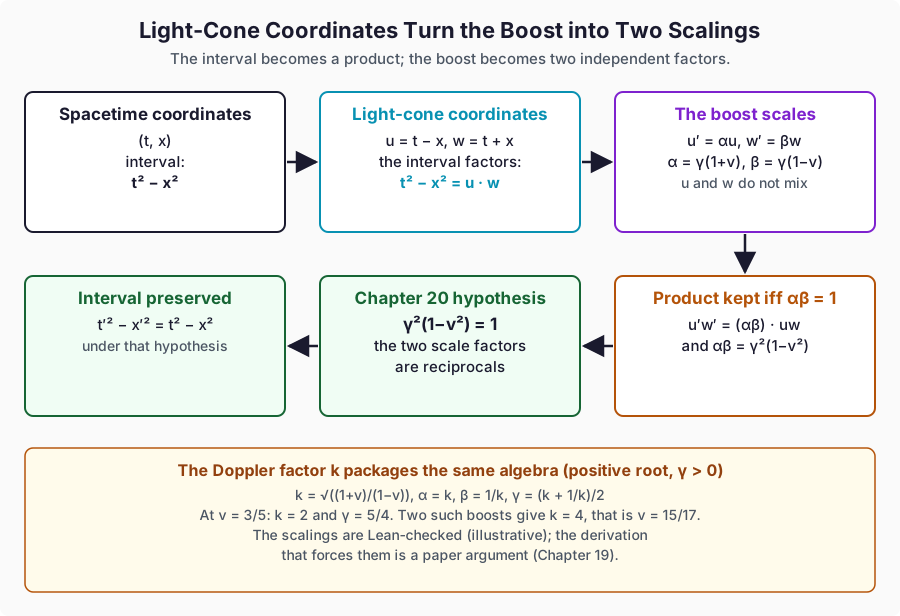
Light-cone coordinates. The boost becomes two independent scalings; the Chapter 20 hypothesis becomes the statement that those scalings are reciprocals.
Deriving the boost
Assume what Chapter 18 listed: linearity (from homogeneity), light speed $1$ in both frames, reciprocity, and that $S'$ moves at $v$ relative to $S$.
- Light stays light. Light moving right is $u=0$; light moving left is $w=0$. A linear map that sends each light line to a light line must scale the light-cone coordinates separately: $u'=\alpha u$, $w' = \beta w$. (The other possibility, swapping the two, reverses the spatial direction and is excluded by orientation.)
- The origin of $S'$ moves at $v$. Its worldline $x'=0$ means $u'=w'$. On the line $x=vt$ we have $u = (1-v)t$ and $w=(1+v)t$. Setting $\alpha(1-v)t = \beta(1+v)t$ gives $\alpha/\beta = (1+v)/(1-v)$.
- Reciprocity and mirror symmetry. The inverse transformation scales $u$ by $1/\alpha(v)$ and $w$ by $1/\beta(v)$. Reciprocity says the inverse is the boost with $-v$, which scales $u$ by $\alpha(-v)$. Mirror symmetry (isotropy) swaps $u$ and $w$, so $\alpha(-v) = \beta(v)$. Together, $1/\alpha(v) = \beta(v)$, that is, $\alpha\beta=1$. This is where premises beyond the two famous postulates enter: items 4 and 6 of Chapter 18.
- Solve. From $\alpha/\beta = (1+v)/(1-v)$ and $\alpha\beta=1$ we get $\alpha = k$ and $\beta = 1/k$, with $k^2 = (1+v)/(1-v)$ and $k>0$.
- Recover $\gamma$. Since $t = (u+w)/2$, $$ t' = \frac{\alpha u + \beta w}{2} = \frac{k + 1/k}{2}\,t - \frac{k - 1/k}{2}\,x . $$ Comparing with $t' = \gamma(t-vx)$ gives $\gamma = (k+1/k)/2$ and $\gamma v = (k-1/k)/2$. With $k^2 = (1+v)/(1-v)$, $$ \frac{k+1/k}{2} = \frac{k^2+1}{2k} = \frac{1+v+1-v}{2\sqrt{1-v^2}} = \frac{1}{\sqrt{1-v^2}} . $$
That is the Lorentz factor, derived rather than postulated.
Paper-only lemma assumptions (Steps 1 and 3). Step 1 assumes an invertible linear map of the two light-cone coordinates that preserves both null lines as sets, with nonzero scale factors $\alpha$ and $\beta$, and excludes the orientation-reversing swap. Step 3 assumes reciprocity (the inverse boost is the boost with $-v$), mirror isotropy, and the stated group and composition structure. These are paper lemmas, not separately encoded Lean or Rocq theorems, and they are not consequences of light-speed invariance alone. The table below records their evidence standing rather than promoting them to kernel results.
What was and was not machine-checked
| Step | Status |
|---|---|
| The boost scales $t-x$ and $t+x$ (formulas above) | Lean-checked, illustrative |
| $\alpha\beta=1$ iff $\gamma^2(1-v^2)=1$ | Lean-checked for the “if” direction, illustrative |
| Step 1: null-line preservation forces $u'=\alpha u$, $w'=\beta w$ | Paper only |
| Step 3: reciprocity forces $\alpha\beta=1$ | Paper only |
| Step 5 at $v=3/5$: $k=2$, $(k+1/k)/2 = 5/4 = \gamma$ | Executed with exact rationals |
| Step 5 for symbolic $v$: $(k+1/k)/2 = 1/\sqrt{1-v^2}$ | SymPy simplify fails to reduce it to 0 (executed); done by hand above |
The last row is Chapter 9’s lesson in the wild. Asked to reduce
$(k+1/k)/2 - 1/\sqrt{1-v^2}$ with $k = \sqrt{(1+v)/(1-v)}$, simplify returned a
nested radical, not 0. Reparameterizing with $v = (k^2-1)/(k^2+1)$ left
$\sqrt{k^4+2k^2+1}$ unrecognized as $k^2+1$. In the engine’s adapters either
outcome would be inconclusive: failing to simplify is not a refutation. The hand
argument is a one-line fraction addition, and it deserves a kernel proof before it
earns a status.
Other ways to describe a boost
| Parameter | Definition | Value at $v=3/5$ | Why it helps |
|---|---|---|---|
| Velocity $v$ | $\lvert v\rvert<1$ | $3/5$ | Operational |
| Lorentz factor $\gamma$ | $1/\sqrt{1-v^2}$ | $5/4$ | Appears in the formula |
| Doppler factor $k$ | $\sqrt{(1+v)/(1-v)}$ | $2$ | The boost multiplies $u$ by $k$ and $w$ by $1/k$ |
| Rapidity $\varphi$ | $\ln k$, with $v = \tanh\varphi$, $\gamma = \cosh\varphi$ | $\ln 2$ | Boosts compose by adding $\varphi$ |
Composition falls out of the $k$ form: two boosts multiply their $k$. Executed: two boosts with $v=3/5$ ($k=2$ each) compose to $k=4$, and $v = (k^2-1)/(k^2+1) = 15/17$. The velocity-addition formula $(v_1+v_2)/(1+v_1v_2)$ gives the same $15/17$ (executed).
The $k$ form also explains why $\gamma$ is natural. It is the average of $k$ and $1/k$, while $\gamma v$ is half their difference: the hyperbolic cosine and sine of the rapidity.
What this establishes
| Claim | Standing |
|---|---|
lorentz-interval-invariance-1d-algebraic@1.0.0 |
Kernel-accepted in Lean and Rocq (Chapter 20) |
lorentz-interval-invariance-1d-physical@1.1.0 |
Kernel-accepted composition (Chapter 20); R4 bundle |
| (not in repository) derivation of the boost from linearity, reciprocity and light-speed invariance | Paper argument only |
| (not in repository) velocity addition as the composition of boosts | Illustrative checks only |
The derivation shows that the Lorentz transformation is the unique linear transformation consistent with the premises of Chapter 18. It is therefore a statement about what follows from those premises; whether the premises hold in nature is untouched. A different set, for instance one without reciprocity or with a preferred frame, can give different transformations, and the engine would treat each as a different claim.
Steps 1 and 3 are where a reader should push. Step 1 has a subtlety: linear maps that preserve the null cone also include scalings and reflections, and the argument has to exclude them. Step 3 is where an extra premise enters. No independent review is recorded.
Try it yourself
uv run python content/examples/math/part3/part3_kinematics_demo.py
cd formal/lean && lake env lean ../../content/examples/math/part3/part3_lean_demo.lean
The Lean file
(download) should print one
#print axioms line per theorem and no errors. All nine read
[propext, Classical.choice, Quot.sound].
Seeded errors. In the Lean file, change gamma * (1 - v) to
gamma * (1 + v) in boostPlus; ring should fail. In the derivation, drop
reciprocity (step 3) and see what freedom remains: $\alpha\beta$ becomes an
unknown function $f(v)$, and the interval is scaled by $f(v)$ rather than
preserved. Light-speed invariance alone does not exclude that scaled family.
Exercises.
- Compute $k$, $\gamma$ and $\gamma v$ for $v = 5/13$. (Answer: $k = \sqrt{(18/13)/(8/13)} = 3/2$, $\gamma = (3/2+2/3)/2 = 13/12$, and $\gamma v = (3/2-2/3)/2 = 5/12$.)
- Compose a boost of $v=3/5$ with one of $v=5/13$ by multiplying Doppler factors. What is the combined velocity? (Answer: $k = 2\cdot\tfrac32 = 3$, so $v = (9-1)/(9+1) = 4/5$; the addition formula gives $(3/5+5/13)/(1+3/13) = 4/5$ too.)
Open questions.
- Is step 1 airtight as stated, and what is the minimal formal statement of “linear map preserving the null cone”? A Lean statement would force the answer.
- Does reciprocity follow from isotropy plus the group structure, or is it an independent premise? Textbooks differ.
- Can the derivation be stated as one versioned claim whose assumptions list the six premises of Chapter 18? That would turn this chapter’s paper argument into something the engine could check or refute.
Evidence record
Qualified: the Chapter 20 evidence. Illustrative only: the exact-rational scale factors and the Lean identities above. Neither the derivation nor the composition law is an engine claim. The Lean identities have no Rocq or SymPy counterpart, except the exact-rational factors, which SymPy computed.
Sources
The derivation is a standard light-cone-coordinate argument. No repository source records it, and no specific textbook derivation is cited. Background:
- Albert Einstein, “Zur Elektrodynamik bewegter Körper”, Annalen der Physik (1905), https://doi.org/10.1002/andp.19053221004
- H. A. Lorentz, “Electromagnetic Phenomena in a System Moving with Any Velocity Smaller than that of Light”, Proceedings of the Royal Netherlands Academy of Arts and Sciences (1904)
- Edwin F. Taylor and John Archibald Wheeler, Spacetime Physics: Introduction to Special Relativity (W. H. Freeman, 1992)
In the repository: experiments/relativity/special/lorentz-physical-1.1.0.claim.json
and the sources of Chapter 20.