The Singularity Is Here
For decades, the technological singularity has been presented as a future event. At some point, an artificial intelligence would become as intelligent as a human being, improve itself, become superintelligent and accelerate beyond our ability to understand or control it. Humanity would stand on one side of that moment and something fundamentally different would exist on the other.
It is a dramatic story, and it may be the wrong one.
On July 25, 2026, Sam Altman appeared on the Relentless podcast and, while answering a question about what drives him, said something unusually direct:
“We are now, like, in the singularity.”
He added, “This is the moment,” and described the singularity as something he and his colleagues had once discussed over lunch without entirely believing they would live to see it. He had made a similar argument in his June 2025 essay The Gentle Singularity, where he wrote that humanity was already past the event horizon and the takeoff had begun.
Altman is not a neutral witness. As the chief executive of OpenAI, he has every commercial and institutional reason to present AI as historically important. Talk of the singularity attracts investment, talent, customers and attention to his company.
His statement proves nothing on its own. It is nevertheless notable that someone with unusual access to frontier AI systems now uses the word singularity to describe the present rather than a remote future.
I think he is right, although not for the reason traditionally associated with the word.
I am using singularity to describe a practical threshold: the point at which machine capability, incorporated into human systems, begins materially changing the scale and structure of cognitive work.
There will be no single date on which everyone agrees that this happened. It is a marker for a period, the kind of transition that becomes obvious only in hindsight. We can ask when the internet age began, but any answer will be an approximation. The network existed before most people used it, and its importance was clear long before its consequences were fully understood.
AI is passing through the same kind of transition.
An individual can now describe a software system and watch much of it being built. A programmer can give an unfamiliar repository to an AI and ask it to inspect the code, propose an architecture, write the implementation and prepare the tests. Similar changes are taking place in research, writing, analysis, design and planning.
These activities are no longer performed only inside a human mind. They are becoming processes conducted between a person and a machine.
The singularity did not arrive as a machine waking up. It arrived as a change in what one person could do.
We Put the Threshold in the Wrong Place
The popular definition of the singularity assumes that intelligence is a single measurable property, that machines must reach some complete version of human intelligence before they can transform society, and that the decisive change will happen suddenly through autonomous self-improvement.
None of that has much connection to the point at which work and society actually change.
A technology does not need to reproduce the entire human mind before it can replace or extend large parts of human labour. It needs to perform enough useful tasks, with sufficient speed and reliability, to change how work is organised.
A calculator does not understand mathematics as a mathematician does, yet it transformed the value of manual calculation. An excavator does not understand construction, yet it replaces the physical output of many workers.
In the same way, an AI does not need consciousness, ambition or a private interior life before it can transform cognitive work. Sufficient capability, placed inside a useful process, is enough.
That has already happened.
The Productive Unit Is Becoming a Human-AI System
The important threshold was never the moment when a machine became indistinguishable from a human being. It was much lower: the point at which one person working with AI could reliably produce more, or better, work than two comparable people working without it.
Once that can be demonstrated in any meaningful field, the economic direction becomes clear. AI does not have to replace the worker or reproduce the whole human mind. It only has to make the person using it more capable than the people who are not.
That is how technologies take hold.
In software development, I believe we have crossed that threshold for a growing number of structured tasks. A skilled person who knows how to work with current AI systems can produce more or better work than two similarly capable people working without them.
This will not be true for every programmer, every project or every day. It becomes possible under particular conditions: when the AI is connected to the repository, the tests, the documentation and the history of the work.
The advantage does not come from opening a chat window. It comes from constructing a system in which the model can participate in the process.
That is why the productive unit is changing shape. It is increasingly a person surrounded by models, tools, tests and accumulated context. This is more than one human using one tool. It is a human directing a growing system of machine capability.
The same person can move between roles that previously required separate specialists. They can investigate a market, design a product, build the software, write the documentation, analyse feedback and plan the next version.
Once that happens, the abstract comparison between human intelligence and machine intelligence becomes less useful. The economically meaningful comparison is between an unaided person and someone who knows how to construct and direct a human-AI system.
The difference will appear not only in speed, but in the scale and range of work each person can realistically attempt.
Coding Is Where the Change Is Easiest to See
Programming provides the clearest demonstration, not because AI writes flawless code or because programmers are no longer needed, but because software development gives AI a structured environment in which it can act and receive feedback.
A modern AI-assisted workflow can inspect a codebase, trace dependencies, propose architectural changes, write an implementation, create and run tests, examine failures, respond to review comments and update documentation.
No single generated file is the achievement.
The breakthrough is the loop.
The repository provides context. Tests provide evidence. An issue records intent, a pull request records the proposed change, and review exposes weaknesses. The AI can revise its work in response, while the project history gives the next interaction a record of what happened before.
The intelligence is therefore not contained entirely inside the model. It also exists in the process around it.
That does not mean the surrounding tools are secretly doing all the work. The same process wrapped around an incapable model produces very little. The loop amplifies the model’s capability by giving it context, actions, evidence and repeated opportunities to improve its work.
This is why an isolated prompt is such a poor measure of what AI can do.
The real capability appears when the system can inspect, act, test, compare, revise and continue. The model is no longer merely answering a question or suggesting the next line of code. It is participating across several stages of a complete task.
The effect then begins to compound. Better tools allow the system to handle more of the process, while the process produces better tests, documentation and context for the next attempt.
The progress is finite and dependent upon infrastructure, but it does not need to be infinite to transform the work.
Offloading Thought
Humans have always moved parts of themselves into tools.
Writing carries memory outside the mind. Calculators perform arithmetic. Maps externalise navigation. Machines replace physical effort.
AI extends that pattern into interpretation, comparison, synthesis and production.
A programmer no longer needs to understand every line of a large codebase before making a useful change. The AI can map the relevant area and explain how the pieces connect.
A researcher does not need to read every document before beginning an analysis. The system can retrieve, compare and organise the material.
A writer does not have to approach each draft from a blank page. An argument can be developed through conversation, tested against alternative structures and examined for contradictions.
The person still determines what they are trying to achieve and what matters to them. Even with that qualification, less of the complete process has to remain inside one person’s head.
This is more than a productivity improvement. It changes what expertise looks like.
Expertise increasingly includes the ability to construct, direct, inspect and improve the systems through which the work is done.
The New Economy Is Still Being Invented
Information workers have absorbed enormous technological changes before.
The word processor replaced the typewriter. Personal computers placed specialist tools on every desk. The internet changed how information was found, shared and organised. Voice recognition, cloud software and mobile devices changed the process again.
AI belongs to that history, although it may eventually prove to be the largest step in it.
Its immediate effect is not to remove the information worker but to extend what that person can do. The role begins to move from operating separate tools towards thinking through a collection of them. More possibilities can be investigated before a decision has to be made, and more ambitious ideas can be tested before an organisation commits significant resources to them.
Meanwhile, the United States has made an extraordinary investment in the technology. The largest technology companies are committing enormous sums to chips, data centres, energy and networking. Microsoft alone said it expected to invest roughly $190 billion in capital expenditure during calendar year 2026.
The infrastructure is arriving before we fully understand what it will be used to build.
That is normal. Carl Benz completed his first automobile in 1885 and applied for its patent in January 1886. More than thirty years later, horse-drawn streetcars were still carrying passengers in New York City, with the final service operating in the summer of 1917.
The technology had clearly arrived long before the city had reorganised itself around it.
AI may spread more quickly because software can be distributed almost instantly, but companies, professions and social habits do not move at software speed. Organisations have existing systems, employees, customers and established ways of working. Even when a new capability becomes available, it takes time to discover what should be changed and what should remain.
We are inside that discovery period now.
The economic return from AI will not come entirely from doing the same work with fewer people. That is the narrowest possible use of the technology. The larger opportunity comes from allowing people to attempt work that was previously too expensive, specialised or difficult.
My own experience of technology is that it tends to multiply work.
The internet made communication and distribution cheaper, but the result was not a world with nothing left to do. It produced more services, more media, more software and more systems requiring design, maintenance, security and improvement.
AI could produce a similar expansion. Once ideas become easier to implement, more ideas will be attempted. We may see new forms of entertainment, personalised software, interactive stories, simulated environments, educational experiences and specialised research tools.
Products can be built for audiences that were previously too small to serve economically. Individuals can attempt projects that once required a company. Small teams can move into areas that were previously closed to them by cost or complexity.
Artistic expression and engineering may also move closer together. A person may be able to imagine an experience, describe how it should behave, shape its appearance and direct machines to construct much of it. The distance between having an idea and testing that idea in the world becomes shorter.
The work surrounding the technology will expand as well. Models need context and preparation. New systems must be designed, connected, tested and maintained. Entire categories of work may emerge that are difficult to name today because the products and industries surrounding them do not yet exist.
Some tasks will shrink, some roles will change and some companies will fail to adapt. The transition will not happen evenly. But history gives us little reason to believe that there is a fixed quantity of useful work waiting to be completed.
New capability creates new expectations, new experiences and new problems worth solving.
We do not yet know what the new economy will look like. We know that the means of creating it have arrived.
The Superintelligence Distraction
The argument over AGI asks whether a machine can reproduce some complete and poorly defined version of human intelligence. The traditional singularity story goes further. It imagines that once this threshold is crossed, the machine will repeatedly improve itself until its intelligence becomes almost unlimited.
Neither idea is necessary to explain the transformation already under way.
The fairy tale is not that AI will become vastly more capable. It almost certainly will. The fairy tale is that intelligence can detach itself from cost, energy, matter, time and engineering, then accelerate towards infinity.
Everything visible in AI development points to a difficult physical and engineering process. Moving from one generation to the next requires new architectures, better data, more capable hardware, enormous quantities of power and a great deal of evaluation, debugging and ordinary practical work.
AI will increasingly assist with that development. Better systems will help researchers write code, analyse results, design experiments and improve the tools used to build the next generation. Development cycles may become faster, and each generation may contribute to the construction of the one that follows.
What does not automatically follow is a frictionless escape into infinite intelligence. A process can accelerate while remaining expensive, difficult and constrained by the physical world.
Trying to build an infinitely intelligent machine is like trying to build a car that travels at the speed of light. It sounds impressive, but it is not what the technology is for. A car exists to take someone somewhere safely, reliably and at an acceptable cost. Beyond a certain point, additional speed creates harder problems without making the car more useful.
AI is similar. A useful system does not need to know everything or solve every possible problem. It needs to perform the task in front of it accurately enough, quickly enough and cheaply enough to justify its use.
The arithmetic shows how little this argument depends upon infinity.
The following graph begins with AI at one unit of human-equivalent capability. It then compares two hypothetical paths over the next fifty years: capability doubling annually and capability improving by 20 percent each year.
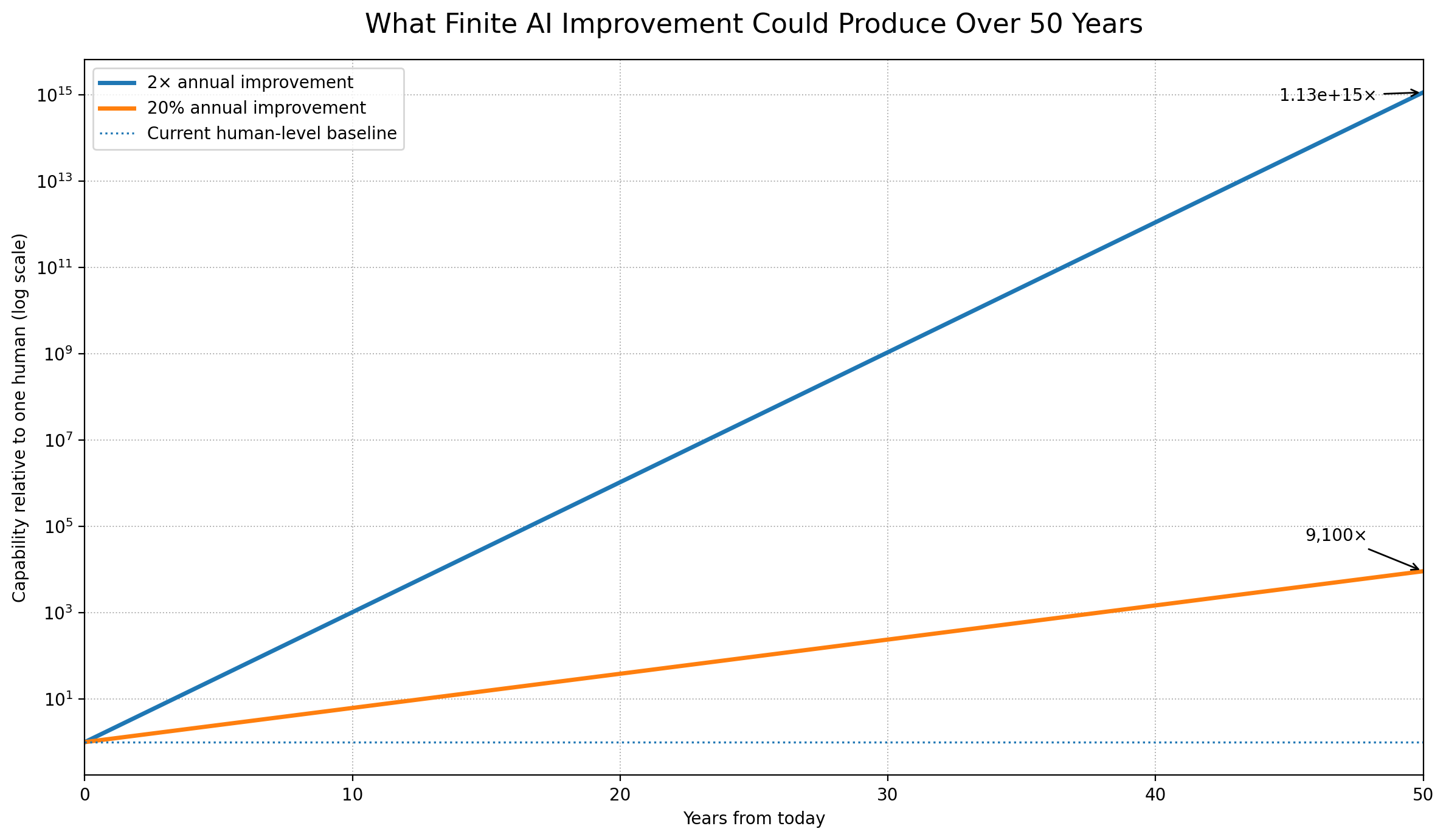
These curves are illustrations, not forecasts. Capability is being used as a simplified measure of the useful work a system can perform, rather than as a literal measurement of intelligence. The vertical axis uses a logarithmic scale.
Even the more modest path produces an extraordinary result. An annual improvement of 20 percent compounds to approximately 9,100 times the starting capability after fifty years.
Annual doubling would produce approximately 1.1 quadrillion times the starting capability over the same period.
Neither path is likely to continue smoothly for five decades. Physical limits, diminishing returns, economics and the difficulty of finding further improvements would intervene. The numbers are not predictions. They illustrate how rapidly finite progress accumulates.
The important point is that intelligence does not have to become infinite. It does not even have to improve at an unbelievable rate. A long sequence of difficult, limited improvements can still produce systems that appear almost incomparable with those available today.
From our perspective, even a partial run of that compounding could eventually look like superintelligence, despite every individual system remaining finite and every improvement still requiring real engineering work.
Whether stronger forms of autonomous self-improvement eventually emerge is a separate question. The transformation described in this article does not depend upon them.
A succession of better models, better tools and better processes is already enough.
What This Means for You
What should AI mean for you?
Whatever you decide to make of it.
The first step is to use it and understand where it is genuinely useful. Most people still encounter AI through a chat box. They ask a question, receive an answer and close the window.
That is a natural place to begin, but it captures only a small part of what the technology can do.
The larger change begins when AI moves out of the chat box and into a process.
For a programmer, that means allowing it to work with the repository, tests, issues, documentation and review history.
For a writer, it means connecting it to notes, research, drafts, decisions and revisions.
In another profession, it may mean helping to prepare information, compare possibilities or maintain the context around a long-running task.
The particular process will be different for every person. The principle is the same: AI becomes more useful when it can participate in the work rather than merely talk about it.
AI output is not the product. The product is the complete system through which an intention becomes a result.
The purpose is not to follow a universal prescription for how AI should be used. There is no single correct answer. It is to decide where the machine can extend your memory, attention, reach or ability to explore possibilities.
A capable AI trapped inside an isolated conversation remains an adviser. Connected to the materials, tools and feedback loops through which real work is performed, it becomes part of the working system.
Building that system is itself work, and there is a learning curve. The practical challenge of the next few years will not be asking increasingly clever questions inside a chatbot. It will be finding ways to bring machine capability into the processes through which we actually create things.
That is where the amplification happens.
The technology is here. What it becomes in your own work and life is still yours to decide.
