The Final Extent of Language
The closing test of Language: does an accountable mediation layer help people reconstruct what matters better than ordinary communication, without losing source fidelity, agency or control? The book separates the communicative thesis from memory, prediction and governance, inventories what has actually run, and states what evidence could narrow or defeat it.
The book began with a registrar at the end of a night shift, handing over a ward of twenty patients in perhaps ten minutes. She gave a few sentences per patient, some numbers, and a gesture towards the man in bed seven. She remembered a worry that had not become a formal alert, so the day team had to decide what to do with the fragments she could pass on. What she held in mind was richer than her message, and what the next team reconstructed would not necessarily be what she meant. Chapter 1 drew the simplest picture of that gap:
sender's intent  →  representation  →  receiver's reconstruction
       (not directly accessible at either end)
The handover remains the test case. An intelligent channel could make the pending result and the registrar’s uncertainty harder to miss. It could also turn a hesitant warning into a confident but dangerous summary. The channel’s apparent intelligence would tell us little without checking what the day team actually understood. This final chapter asks what was added to the original picture, what remains only proposed, and where the word language stops describing the problem.
What has Language become by the end of the book, and at what point does “language” stop being the right description?
What was inserted
The four parts each expanded a different part of the original gap. Part I looked at representations and the obligations that come with transforming a source while keeping its meaning intact. Part II asked what deserves attention and what should be withheld, deferred or left available. Part III examined the permitted use of memory, current context and bounded personalisation. Part IV distinguished prediction, desired participation, authority, speech and the population-level effects of proxies (stand-ins that act on someone’s behalf). These are interacting concerns, not mandatory stages that every message must pass through. A plain handover may need none of the optional personal machinery.
INTENT  [not directly observable]
          ↓ expression
SOURCE + DECLARED PURPOSE
          ↓
A: PROPOSED SOURCE UNDERSTANDING
          ↓
AI MEDIATION → DELIVERED REPRESENTATION → B: PROPOSED DELIVERED MEANING
                        ↓
              RECIPIENT RECONSTRUCTION  [not directly observable]
                        ↓
              OBSERVABLE RESPONSE → C: PROPOSED RESPONSE MEANING
                        ↓
              SOURCE-GROUNDED SEMANTIC COMPARISON
                        ↓
              CORRECTION / CLARIFICATION → NEXT COMMUNICATION

optional: permitted current context and personal policy shape a view
separate: prediction proposes; explicit grants gate any external act
outside: collective capacity, counterparty rights and governance
This is not a new pipeline that replaces the simple message. It is a possible feedback loop around representations. An interpretation is proposed, a view is rendered, someone tries to use it, a failure can be traced, and the next view can be corrected. A receiver’s reconstruction cannot be read directly from a fluent response, a click or an acknowledgement. It needs evidence suited to the task. Prediction may help with some presentation choices, but it is not a prerequisite for meaning to pass. Delegated action is a separately authorised consequence of communication, not its inevitable final stage. What makes the channel interesting is the possibility of accountable adaptation, meaning changes that can be inspected and traced back to their basis. The number of mechanisms in its diagram is not the point.

The Understanding Compiler makes the inspection points explicit. A proposes what the source communicates. B proposes what the mediated representation communicates. C proposes what an observable recipient response communicates. Comparison asks what was preserved, omitted, changed or added for the declared task, and it keeps track of uncertainty and of what was not assessed. It must allow a correct short answer without demanding that the answer repeat the whole source. Shared extractor errors can make all three inventories agree and still be wrong, so independent, source-grounded evaluation remains necessary.
The research question is now more explicit: can an intelligent channel inspect, transform, compare and correct proposed meaning in ways that measurably improve what a recipient can recover and apply? This loop gives us places to test the question. It does not answer the question, and it does not reveal a model’s internal mental state.
Language moves up the stack
The book’s proposed change can now be stated as a testable engineering hypothesis. It is not a finished account of how language itself has evolved. Existing communication already involves shared context, repair and collaboration. The novelty claimed here is narrower: software might maintain an inspectable working interpretation, and compile different accountable representations from it when a particular task calls for them.
Language moves up the stack, in this book’s hypothesis, when an accountable working interpretation can support multiple task-appropriate representations without losing the distinctions a receiver needs to reconstruct and use the source.
The proposed state may contain a declared objective, source-linked claims and relations, unsettled interpretations, preservation requirements, and the minimum current context and policy permitted for the task. It is a fallible, revisable working interpretation of what was expressed. It is not a direct store of anyone’s inner intent, and it is not meaning itself. Every generated paragraph, diagram, warning, typed decision or choice to leave the source alone should be traceable to that interpretation and to the original evidence. A booking or message sent to a third party is different. It has effects outside the representation, so the action and data-use gates described in Part IV must authorise it separately.
source kept available
        ↓  interpreted, with evidence and unresolved choices
working state (not verified meaning)
        ↓  rendered for a permitted task
view / decision / unchanged source
        ↓  tested through reconstruction and use
repair the interpretation, view or policy as needed
Nothing requires prose to disappear. In many tasks the original page, a direct conversation with a colleague or an ordinary search is the right interface. The more demanding architecture has to earn the right to replace any of them. In particular, rendering from structured state must not quietly displace the source as the record of what was said. A successful design keeps a route from any consequential output back to the evidence, the unresolved interpretation and the decision that used it. Where it cannot provide that route, it should not pretend that a fluent explanation is a causal record.
Chapter 12’s scripted job-queue example showed why this matters. A machine-facing, typed answer could be checked against a chosen reading of “executed”, while a different reading exposed a double charge. That fixture tested the link between an option, its definition and its source. It did not show that the correct human reading had been chosen, or that a real model communicated better. A working state is not verified meaning, a checked decision is not necessarily a good decision, and an explanation written after the fact is not evidence that it describes the decision’s cause. The larger hypothesis must pass all three of these boundaries. Removing prose from view is not enough.
The medium may also leave traces of its own operation. Chapter 35 called Taint the hypothesis that repeated interaction could produce a detectable, co-produced pattern. It did not report a working detector or a useful match. Even if such a pattern could be measured, it would mix human choices with models, prompts, tools and circumstances. Turning it into a personal explanation, a discovery feature or a cross-context profile would be another inference, and another decision about authorisation. The proposed channel must be accountable for what it retains and derives, as well as for what it sends. Taint is neither a necessary part of the language thesis nor proof that the channel knows the person.
Where the word stops
It would be tempting to finish by saying that all mediated intelligence is language. That definition could explain everything and test nothing. The boundaries established across the book should stay visible instead:
communication ≠ retained memory
representation ≠ receiver understanding
prediction ≠ permission
permission ≠ execution or correctness
local authorisation ≠ population-wide legitimacy
Communication draws on memory, but a stored fact’s truth, currency and permitted use are separate questions from its role in a given message. Prediction may suggest a view, but a good prediction score does not establish benefit. An explicit grant can permit a consequential act, but grants need enforcement, and they do not guarantee the act’s quality or its outcome in the world. Governance determines the rights, capacity and remedies under which many such acts can coexist. Calling these distinct systems language would hide their independently testable failures.
The term language remains useful when the central question is whether an expressed purpose or distinction survives representation, interpretation and reconstruction across a boundary between humans and machines. That can include a diagram, an accessible interface or a typed, machine-facing statement, because their communicative role can be examined. When the main question becomes who may purchase something, whose private information may be disclosed, whose attention a request may consume, or how a scarce channel is governed, language is still involved. It is no longer the sufficient category of explanation. Those are problems of authority, privacy, transaction control and collective governance. Chapter 37 reached that boundary. The conclusion should not solve it by renaming it.
The distinctions that remain
Across the four parts, the argument refused to let one kind of evidence or permission stand in for another. The most important separations can be read as tests that the design must keep passing:
expression ≠ intent                 source words cannot settle the author's mind
representation ≠ reconstruction    a rendered answer is not demonstrated understanding
available ≠ relevant ≠ authorised  memory retrieval is not permission to use
preference ≠ performance           what feels good may not help
current context ≠ durable policy   one urgent session should not become a trait
visible ≠ valid ≠ authorised       inspection cannot legitimise an inference
prediction ≠ identity ≠ authority a forecast cannot speak or act for a person
desired role ≠ grant               wanted assistance is not unlimited permission
matching ≠ reveal ≠ introduction  finding a candidate cannot release identity
permission to send ≠ admission    another person need not attend
local authorisation ≠ global safety many permitted requests can overwhelm a channel
These distinctions constrain different parts of the system. Source and reconstruction checks stop a polished representation from hiding a lost qualification. Separate memory and personal-policy boundaries stop an old observation from becoming a present instruction. A forecast cannot authorise a reply, and a grant cannot by itself show that the reply was delivered or the booking completed. A match cannot reveal someone’s identity simply because an algorithm found it. A sender’s permission cannot override a receiver’s right to refuse. The framework’s value lies in keeping these failures distinguishable and correctable, rather than folding them into one claim that “the AI understood”.
In particular, an interaction trace is not the person whose work helped produce it. Taint-based affinity, if it proves useful at all, would remain a proposed reason to investigate a purpose-specific connection. A relationship still requires evidence, and any identity reveal, introduction or disclosure still requires independent permission. That possibility belongs at the exploratory edge of the book, not in the minimum mechanism needed to test the language thesis.
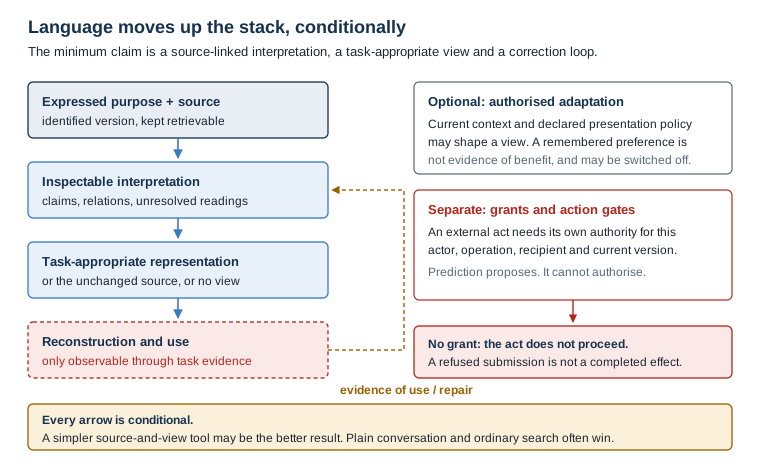
The minimum research claim is therefore smaller than the full architecture. It asks whether a source-linked interpretation can support a task-appropriate view and a usable correction loop, while keeping the source, constraints and unresolved choices open to inspection. Personal adaptation and agency are optional extensions, each with its own evidence burden:
expressed purpose + source
         ↓
inspectable interpretation  →  task-appropriate representation
         ↑                                   ↓
         └────── evidence of use / repair ← reconstruction

optional: authorised adaptation to current context
separate: explicit delegation, action gates and collective rules
Each arrow is conditional. The original must remain retrievable. The interpretation must record what is uncertain and what must survive. A receiver must have a way to check, reject or correct a proposed view. Optional personal state requires valid provenance and authority, and external acts require grants that are independent of prediction. A failed requirement cannot be excused by better prose or a more elaborate architecture. This is also why the proposal may properly stop at a simpler source-and-view tool.
The edge of the horizon
One further frontier belongs here only as a horizon. Research prototypes have decoded attempted speech from recorded neural activity in participants with paralysis, under trained and constrained experimental conditions (Willett et al., 2023). Other work reconstructed aspects of language-related meaning from non-invasive recordings, with substantial training and cooperation requirements (Tang et al., 2023). Neither is unconstrained access to a person’s thoughts, and neither is evidence for this book’s mediation architecture. If additional pre-verbal or non-verbal signals ever became usable in communication, they would make it more important to separate inference, intended expression, consent and transmission.
measured signal ≠ intended expression
reconstructed words ≠ verified intent
intent ≠ permission to transmit
prediction ≠ authority to act
A decoder’s candidate words must not be treated as a self-authenticating statement or a grant. The person needs an available means of confirmation, correction and control suited to the setting, and a failed or uncertain decoding must remain uncertain. This horizon does not require the book to become a theory of neural interfaces. It shows the same communication boundary under more demanding evidence conditions.
What would count against it
An unbounded thesis, such as “all language is becoming computation”, could survive any outcome by changing its meaning. The book’s narrower claim can be tested. For declared tasks and authorised evidence, does maintaining a source-linked, inspectable interpretation improve reconstruction or useful action enough to offset transformation errors, correction work, privacy exposure and operational cost, compared with a simpler channel? The architecture does not win merely by producing different output formats or by passing its own schema checks.
The evidence so far is limited and varied. The Semantic Browser, Personal Information Radar and personal mediation examples exercise bounded rules on constructed inputs, through a Pi-hosted scripted stand-in. Their passing checks do not establish human understanding or benefit. The separately used Too Much YouTube scan processed real subscription metadata and recorded deterministic filtering decisions. It did not measure those decisions’ value to a reader. The author’s production count describes output volume, not another person’s comprehension. The proposed delegation, private-discovery and proxy-ecosystem mechanisms have not been validated as end-to-end real-world systems. Taint remains a hypothesis, without a demonstrated detector or a measured matching gain. These are different types of evidence, and none may be promoted into proof of the full thesis.
The compiler adds one narrow implementation fact: a Python spaCy/NLTK baseline produces source-linked segmentation and provisional lexical classifications. Studio documentation reports inventories at the input, delivered-text and observable-response boundaries, with heuristic and unevaluated status retained. The separately reported S-17 development run provides one bounded real-model observation: the receiving model correctly refused an unauthorised public archive release. It is not a held-out, general-understanding result, nor a comparison showing superiority over ordinary communication. Neither the local engineering checks nor that single response establishes the proposed loop’s benefit.
Several outcomes could narrow or defeat the proposal. These are prospective failure conditions, not results. They must be evaluated against tasks, baselines and acceptance criteria declared before outcomes are inspected:
a source-only or ordinary-language baseline is non-inferior
  on decision correctness and reconstruction for the target task

structured representations introduce decisive omissions or
  unsupported additions that the baseline avoids

optional adaptation improves clicks or preference ratings
  but not comprehension, accuracy or appropriate decisions

maintained interpretation provides no detectable improvement
  over explicit current instructions and a simpler renderer

repair and verification cost more human effort than they save
  after errors, abstentions and missed cases are counted

privacy, unauthorised use or uncorrectable downstream effects
  violate binding requirements despite an average score gain

machine-facing state or typed decisions lose a distinction
  preserved by natural language on the same source and tests

benefits disappear on new tasks, sources, readers or contexts
  once leakage and selection effects are controlled
Negative results must be read at the scope in which they were tested. One failed diagram task does not refute every possible mediator. However, a simple baseline that is consistently non-inferior across the intended tasks would undermine the case for keeping the extra layer. A privacy or authority failure may rule out a deployment even when reconstruction improves. If a narrower component works (for example, a source-linked correction view without personal prediction or delegation), then the evidence favours that smaller system. The point of falsifiability is to allow the thesis to contract without moving the goalposts.
The compiler has further prospective ways to fail. False inventories may produce false confidence. A common interpreter may repeat its error at both ends. Comparison may add cost without improving decisions. The plain source may outperform the richer representation. Any apparent benefit may disappear on unfamiliar documents or with different models. These failures must be measured separately from schema validity. The overall argument still runs from developed concepts, through implemented mechanisms and actual observations, to unverified hypotheses. None of those transitions is automatic.
What the system is, and how small it may turn out to be
The book has spoken of a system, but an operational account has to keep the built mechanisms separate from the intended product. The proposed practical form is an experimental communication layer in an OpenCode-like development environment. The reference examples currently exercise bounded Parts I–III mechanisms on a Pi host with scripted model behaviour. They are not an integrated, tested OpenCode plugin implementing all four parts. The candidate responsibilities are:
read a source without replacing its authority
record proposed concepts, relations and unresolved readings
render a view for an explicit task and permitted context
check decisive claims and provide links back to evidence
explain which recorded inputs actually shaped the view
accept corrections and invalidate known dependent outputs
respect current, scoped presentation and data-use policy
optionally: propose actions behind independent delegation gates
These are candidate capabilities, not a checklist that every application must adopt. The only ones that deserve to survive are those that outperform simpler arrangements on their intended tasks while respecting the constraints set out throughout the book. A smaller source-aware renderer with effective correction could be a stronger result than a sprawling personal proxy. Conversely, a beautiful interface that makes users work harder to detect wrong assumptions would not justify its sophistication.
The current status should be clear without mistaking a code demonstration for a finished system:
LANGUAGE — PROPOSED PROGRAMME
  developed in this manuscript: distinctions, examples, test obligations
  exercised in code: bounded scripted Pi demonstrations
  prepared website snapshot: preservation companion (historical Chapter 10)
  prepared reader guidance: a 37-outline snapshot and a Capability Index
  current manuscript: 39 chapters; reader guidance requires a separate migration
  implemented baseline: source-linked segmentation and lexical proposals
  reported Studio mechanisms: inventories at observable communication boundaries
  real-model observation: one S-17 public-release refusal in development
  unverified hypothesis: comparison and correction improve recipient application
  not established: independent semantic fidelity or measured reader benefit
  observed on real metadata: deterministic subscription filtering
  not established: comparative human comprehension or benefit
  not established: an integrated authorised proxy ecosystem
  optional hypothesis: Taint-based candidate discovery
  next decision: which smallest accountable mechanism earns its cost
A final experiment, not a final verdict
The smallest decisive study would return to the source–representation–reconstruction loop. It would select tasks with independently adjudicable, consequential distinctions: the registrar’s uncertainty and pending result in a simulated handover, a technical assumption that changes an architecture decision, or a source whose wording admits two operational readings. It would use only synthetic or properly authorised material. A real clinical handover would need safeguards and expertise that this book does not supply. Before anyone examines performance, the study would freeze the sources, eligible participants, tasks, outcome rubrics, permitted context, time budget and failure thresholds.
It would compare four conditions: (1) the unchanged source; (2) ordinary-language explanation or search, using the same permitted source and current instructions; (3) a structured, source-linked view without optional personal conditioning; and, only if justified, (4) a context-adapted view with explicit policy. It would report separately what was rendered, what people noticed, what they understood, what they decided, and whether the required qualification survived. It would also record false additions, missing evidence, correction attempts, time and cost, accessibility, and any prohibited use of information. Participants may be allowed an explicit cannot safely transform result, and coverage and abstentions would be reported alongside accuracy.
A second, separately authorised protocol could assess machine-facing decisions, testing whether typed state preserves the same source distinctions under held-out ambiguity and changed definitions. A third would be needed for grants, revocation and receipts. A population simulation would test queues and receiver protections, rather than human understanding. These outcomes should not be merged into a single victory score. In each domain, a result must distinguish a valid mechanism, a faithful representation, a real user benefit and a permitted operation. The study should predefine what would justify keeping the added layer, what would trigger narrowing, and what failure would block use even if the average benefit were positive.
The result might favour the original message and an easy way to ask questions. It might favour a diagram with a source link but reject personal memory. It might justify only a narrow typed-decision tool. Each of these would answer the book’s question more usefully than assuming that the most elaborate stack must win.
References
- Clark, H. H., & Brennan, S. E. (1991). Grounding in communication. In Perspectives on Socially Shared Cognition (pp. 127–149). American Psychological Association. https://doi.org/10.1037/10096-006. (Foundational account of communication as coordinated grounding; not evidence for this book’s software.)
- Willett, F. R., Kunz, E. M., Fan, C., et al. (2023). A high-performance speech neuroprosthesis. Nature, 620, 1031–1036. https://doi.org/10.1038/s41586-023-06377-x. (Attempted-speech decoding in a constrained research setting.)
- Tang, J., LeBel, A., Jain, S., & Huth, A. G. (2023). Semantic reconstruction of continuous language from non-invasive brain recordings. Nature Neuroscience, 26, 858–866. https://doi.org/10.1038/s41593-023-01304-9. (Experimental reconstruction requiring trained, cooperative participants; not unconstrained mind reading.)
Where this leaves us
The future of language may not be fewer words, richer words, or even a replacement for words. It may be that words become one accountable rendering of an interpretation, which can also produce a diagram, a warning, a decision or simply the unchanged source. That will count as progress only if the receiver can use the result without losing essential distinctions, and can find and repair whatever the mediation got wrong. If that happens, language has not disappeared. One part of its machinery has moved.
For the registrar, the test remains whether the day team can reconstruct the danger and uncertainty that mattered, rather than merely receiving a polished handover. For Iris, it is whether she can understand the evidence, correct how the system represents her, keep a choice, and withdraw a grant without its effects being hidden. For Daniel, it is whether a legitimate discovery process respects his information and his attention. These are different tests, and none is answered by a single quality score. People remain responsible for the rules under which the channel operates. Receipts and correction paths make its actual conduct inspectable, rather than automatically justified.
How far it moves is an empirical question. What must survive is still the question.